Wednesday, December 30, 2020
10 Best Colorado Beers of 2020

In a year that seemed so dark, maybe, just maybe, it was appropriate that Colorado beer makers stepped up their game particularly in the area of dark ales. To be sure, there was much more that highlighted the year, from barrel-aged barleywines to vibrant hazies to sour experiments that included Japanese citrus-based sauces. But it sure seemed as if the most textured, daring and successful creations of the year that was 2020 were those those turned to the dark side - and made it as enjoyable as possible.
This annual list of Colorado's best beers - at least those determined by one local beer writer - is somewhat challenged this year, as the beer festivals and gatherings that often provide the best look at what the state's breweries are doing did not happen after mid-March. But I tried to drink as much as I could from as many locally sourced creators as I could, and these are the most unique, complex and quaffable beers I found:
10) 4 Noses Lotus Rising

The hazy IPA is, by now, an established beverage, and longer-running gems from Weldwerks' Juicy Bits to Westfax Brewing's Urban Lumberjack made lockdown a lot easier to bear. But the best new addition to the category was this gem from Broomfield's 4 Noses Brewing, simultaneously thick with tropical notes and leaving just enough bitterness on the backtaste to remind you that being hoppy is still an important part of being a delicious hazy IPA.
9) Elevation Beer Montanya

Here is how you make an imperial porter stand out: Add Horchata spices and age it in rum barrels from the distiller of its namesake. This beer never seemed as boozy as its 10% ABV suggested, and every taste produced a bite from a seemingly different spice. But it landed both hugely and pleasantly, particularly if you were camping at the foot of a nearby fourteener, and it reminded you how valuable mountain-town breweries like this Poncha Springs beer maker are to the Colorado ecosystem.
8) Cannonball Creek The Return of the Mackaroon

Here's the other approach to dark beer: Take a traditional stout, made by a brewery known far more for its lagers and pale ales, and infuse it with coconut and macaroon to give it a sweetness that neither overwhelms nor is subsumed by it dark body. Rolled out in the spring, this beer felt like the perfect accompaniment to a brisk spring hike (and paired well with pizza). And it served as a reminder at just how versatile Colorado's most consecutively awarded Great American Beer Festival medalist can be.
7) Spangalang Brewery Ms. Behavin'

Anyone who believes that barleywine is a relic of an earlier time is challenged to drink this beautiful barrel-aged beer from one of Denver's most overlooked breweries and declare that it is anything but a full-mouthed joy. Its body is a like a lightly caramelized, raisins-soaked-in-booze blanket, covering over any sign of it s 12.5% ABV content and presenting a beer so smoothly presented that it forgoes astringency and passes straight to warmth. A masterful update of a classic style.
6) Strange Times Too

Strange Craft Beer has played with its traditional recipes in host of ways for 10 years, but few if any variants have landed as successfully as this Brettanomyces-laced version of its Cherry Kriek, which popped to life with a tartness that added to its fruit base and created enough of an edge to be daring without being at all difficult to swallow. Not all big-sellers should be messed with; this experiment, however, gave a whole new definition to a much-loved beer.
5) Purpose Brewing Itadakimasu #032

The boldest Colorado beer of 2020 was this Fort Collins provocateur's sour ale aged with a citrus soy sauce, creating a taste wholly unlike anything else at the Big Beers, Belgians and Barleywines Festival where it was unleashed in January - which is a statement in itself. Both tart and unusually thick, this caused a minor flinch at first taste, followed by a stunned appreciation of how owner Peter Bouckaert (talking here, left, with Black Project co-owner James Howat) can blend such flavors together. A revelation into the possibilities of creativity.
4) Verboten German Chocolate Cake Not a Speck of Light

Just the second imperial stout produced by the quickly ascending Loveland brewery, this was a masterful effort with three variants, the German chocolate cake version being the one that packed the most flavor into a 13.6% ABV body that was dangerously easy to drink. Aged for more than a year in a blend of barrels, this took on the characteristics of everything that was in it, particularly Ugandan vanilla beans and Ghana cocoa husks, as well as the barrels that gave it more character.
3) Upslope Wild Christmas Ale

After years of producing some pretty sturdy wild-yeast holiday efforts, this Boulder brewery found a whole new dimension by adding Saigon cinnamon to the delicately tart orange flavor, creating a cacophony of tastes that were both funky and strangely sweet on the aftertaste. In many ways, this is the best original Colorado Christmas ale in the past half-decade, daring drinkers to rethink their definition of a holiday beer while still drawing forth a flavor that was spice-enhanced, even if in a radically different way. Let's hope Upslope does not decide to make this recipe a one-off.
2) Wiley Roots Du Hast Cake Imperial Stout

This gigantically flavored beer is everything that the idea of boundary-pushing pastry stouts purports to be - both unnaturally easy despite it big body and adding to the lexicon of flavors that beer, at its best, can bring forward in our taste buds. Here was coconut and chocolate and dessert sweetness layered upon the most solid traditionally dark-beer base that one could imagine. This Greeley auteur has been pushing boundaries for years - creating, for example, a cinnamon sour - but this is arguably its finest experimentation yet, a beer for beer lovers and sweets lovers and anyone who respects liquid adventure.
1) Casey Brewing & Blending No Title

It felt like a stroke of genius to blend three adjuncts that could make this beer un-drinkably sweet - Madagascar vanilla, coconut and almond - with a heavily roasted and slightly bitter chocolate body that turns this imperial stout from Glenwood Springs into a beer that imbues a bolder and seemingly easier flavor with every sip, despite its 10% ABV body. In a year in which tradition flew out the window at the same speed as our expectations of normalcy, this searing rebuke of Rheinheitsgebot laws was like a break from both the past and the present, daring drinkers to imagine a future in which beer styles are not defined so much as cemented by experimentation. From the first pour to the last swig, it was packed with intensely pleasing flavors without any alcohol burn. It was the beer that signaled both an escape from the surrounding landscape of 2020 and from any preconceptions about how much you could add to beer and still, importantly, make it taste like an excellent beer.
Labels: 4 Noses Brewing, Cannonball Creek Brewing, Casey Brewing, Elevation Beer, Purpose Brewing & Cellars, Strange Craft Beer, Top Beers of Year, Upslope Brewing, Verboten Brewing, Wiley Roots Brewing


Monday, January 20, 2020

Once again, the variety and complexity of flavors poured at this year's Big Beers, Belgians and Barleywines Festival - which celebrated its 20th anniversary last weekend in Breckenridge - were awe-inspiring. But this year's masterpiece of a festival from Laura and Bill Lodge felt distinctly like it was not just about what has been produced by some of the most experimental brewers in America but what will be coming from the industry's boundary-pushers for years to come.
New styles, new flavors and new brewers abounded - a trend exacerbated by the number of cutting-edge beer makers who asked to come out and pour this year, adding to the geographical and taste diversity in the hall. And if one walked away with a few predictions as to what more brewers will be doing after tasting their noteworthy brethren, here is what I dare say they would be.
1) Bold adjuncts in stouts are once again on the rise
 If there was a standout beer of the festival, it was Wiley Roots Brewing's Du Hast Cake, a 12% ABV bourbon-barrel-aged German chocolate cake imperial stout that tasted every bit as lusciously desert-like as it sounds - but without a hint of alcohol residue, making it both scrumptious and dangerous. And while pastry stouts have become one of the scapegoats of the "beer doesn't taste like beer anymore" crowd, the only pushback I received when proclaiming this the best beer was from folks who argued Outer Range's Timber from Vanilla Imperial Stout imbued even more awakening flavors.
Indeed, Fremont Brewing's Coconut Edition B-Bomb Imperial Winter Ale and 4 Noses Brewing's Toasted Coconut BMF Imperial Stout proved also how much unique flavor could be added to otherwise big and boozy beers by throwing in something that snubs the Reinheitsgebot. And New Holland Brewing's Dragon's Milk Reserve Oatmeal Cookie tasted of vanilla, cinnamon and brown sugar - not at all of its 11% ABV holdings.
2) Fruit in a sour? How about vanilla, or an Asian soy add-on?
There were, as always, a profusion of both pucker-worthy and smooth-settling sour ales on display at the festival, but there was nothing as remarkable as Purpose Brewing's Itadakimasu #032, which infused the sour rice wine Ponzu into its body and created an entirely new flavor profile. Partly salty and thicker in body than most sours, this is not a beer that will appeal to everyone but absolutely was the gutsiest and most high-risk/high-reward offering of the festival for those willing to drink a beer and mull over it for a significant time, and Purpose owner/brewer Peter Bouckaert (shown below listening to Black Project owner James Howat at a festival seminar) should be commended for his boldness.

Slightly less edgy but no less satisfying was the Language of Origin Sour Ale from Speciation Artisan Ales of Michigan, aged in gin barrels with strawberry, hibiscus, vanilla and lemon. That radical combination melded, and also allowed its ingredients to stand out in alternating turns as it rolled over your taste buds, and it created something that went far beyond the standard definition of a sour ale.
.
3) If going traditional in your sour adjuncts, ignore the typical barrels
Wine, whiskey and other traditional barrels will continue to be used, and for good reason, in aging specialty ales. But Big Beers showed exactly what one could do by reaching further afield for a supply of aging vessels.
Broken Compass Brewing of Breckenridge poured a Port-Barrel-Aged Foreign Export Stout that used tart cherries to impart a pleasantly acidic nose into a sweet and dark body with a pointedness that was lacking from other adjunct ingredients. Meanwhile, Transient Artisan Ales of Michigan put out an Absinthe Anachronism Wild Ale that gave a cherry sweetness to a funky beer without any pucker and made you think twice about its process.
4) The hazy/tropical IPA is about to get doubled
Big Beers is not as much of a showcase for hop bombs as other festivals, but after sucking down 11% ABV imperial stouts for much of the day, you certainly get to know which IPA offerings can break through even the most overused of taste buds.
Oskar Blues Brewery, which produced arguably the most eye-opening beer of 2019 with its Can-O-Bliss Tropical IPA, ramped up the alcohol in its new Double Can-O-Bliss but still managed a creation that focuses on Polynesian fruit without the burn that sometimes accompanies higher ABV. Meanwhile, Outer Range Brewing of Frisco doubled the dry-hopping in its DDH Leave a Trail IPA and made a beer so juicy and bursting with melon hops that it created a new sub-genre: A hazy for people who like big hazies.
5) Clean saisons and gueuzes are the new experimental

For all the giant, genre-expanding beers poured at Big Beers, some of the subtlest standouts remained cleaner beers of Belgian origin that serve as a reminder why the country's influence should be honored so passionately.
Take, for example, the Atom Brewing 3-Year Blend Anniversary Wild Ale, which not only impresses with its smoothness but with the brewery's ability to find just the right examples of beers that meld into creations that are better than their stand-alone origins. Similarly, Referind Brewing's Le Differend Gueze is wonderfully tart but is more a better version of something that's been made for hundreds of years than a new category of the style.
6) Your journey no longer ends at the exit sign at Big Beers
One of the most brilliant strokes the Lodges came up with this year was the idea of raffling off boxes of 12 beers donated by festival participants. That allowed visitors to take home beers that aren't able to be found in their states - and for the non-profit event to raise more money for groups like the Breckenridge Mountain Rotary.
I won one of those boxes (shown below) after buying a lot of raffle tickets to support the cause. I've been working my way through beer from the likes of Mad Fritz Brewing, Side Project and the aforementioned New Holland Brewing, among others. And it's an idea, for tasting and charitable purposes that a lot of beer festivals should consider.

Labels: Atom Brewing, Big Beers, Broken Compass Brewing, Fremont Brewing, Oskar Blues, Outer Range Brewing, Purpose Brewing, Speciation Artisan Ales, Transient Artisan Ales, Wiley Roots Brewing
Monday, October 09, 2017

The phrase "best Great American Beer Festival ever" is so trite that it could rightfully stop people from listening to the rest of the conversation. But this year, it just might have been true.
Over three days at the Colorado Convention Center and six days at events around town, the beer poured was so daring, so unique, so full of life that it elicited smiles and compliments around every corner, even from the harshest beer critics. From audacious fruit sours with boundary-bending flavors to juicy hop bombs to the bevy of 18% ABV barrel-aged imperial stouts that went down like cocoa at the Denver Rare Beer Tasting, brewers upped the bar on almost every style.
Choosing beers to highlight from both the convention floor and outside events then is difficult - not because there's not enough to make this list but because there's too many that are being left off. But once again, here is one blogger's thoughts on the best creations at the best beer festival in the world.
Best in Show: Speciation Artisan Ales Rhubarb Vanilla Incipient
Former Black Project brewer Mitch Ermatinger put together a tart, intriguing and yet smooth wild yeast golden sour made with rhubarb and Mexican vanilla beans that was the closest thing to a perfect combination of unusual tastes at a festival full of them. And if that wasn't enough, he also was pouring a Tequila-barrel-aged Incipient with blood orange, guava, limes and salt that was the closest thing you'll taste to a beer version of a margarita.

Best Outside the GABF: Ozark Beer Co. Onyx Bourbon Double Cream Stout
Arkansas isn't known for being a brewing mecca. But one sip of this 10.2% stout with flavors of big coffee and fluid cream will make you rethink your visions of the state, as well as of how easy it can be to drink a beer like this.

Even at just 6% ABV, this New England IPA towered over competitors in taste, imbued with Mosaic hops that offered overtones of citrus and melon, all in an incredibly smooth body. Not far behind was Melvin Brewing 2x4, a double IPA so steeped in flowery citrus (yes, that's possible) that you're halfway through the glass before you realize how quickly you've been imbibing this.
Best Dark Treat: Mountain Sun Bourbon-Barrel-Aged Chocolate Thunder Imperial Chocolate Milk Stout
Everything was here: Sweet chocolate, smooth milk, a slight alcoholic bite but one that was far less than you could have expected. Bring on February, as Stout Month at the Denver/Boulder restaurant has never seemed so exciting.
Best Sour Not Made with Rhubarb: Bruery Terreux Oude Tart with Raspberries
In a world where the newest brewery and newest taste sometimes steals the show, this beer demonstrated why a known entity making twists on its classic offering - in this, case, adding raspberries to its Flemish red ale in the final stages of barrel aging to create a simultaneously tart and refreshing beverage - should never be ignored.

Best Lager: Lone Tree Brewing Mexican Lager
Things like simplicity and crispness with just enough of a slightly sweet malt backbone to give a beer heft often are overlooked at a festival of wild and crazy standouts. The gold medal this south Denver brewer won for this subtly brilliant creation (seen at right) shows it should not be forgotten.
Beer That Shouldn't Have Worked But Did: Wiley Roots Brewing Cinna(man)bun
This was a cinnamon vanilla sour. Think about it for a second. Then run up to Greeley to get a shockingly blended barrel-aged golden sour that used the cinnamon to zingy rather than clashing effect, and taste great craftsmanship.
Beers That Everyone Talked About: Weldwerks Medianoche/Medianoche Reserve
One of the simplest tastes from this complex Colorado brewery is its imperial stout, which received a deserved gold medal for presenting a dark, smooth body with notes of chocolate that seemed far too easy to drink. But when it aged said creation for 17 months in bourbon barrels with toasted coconut, vanilla beans and cacao nibs, as it did for Denver Rare Beer Tasting, it became unforgettable.
Beer That Everyone Wondered About: Haw River Farmhouse Ales Sazerac
This North Carolina brewery offered a rye Belgian tripel that tasted eerily similar to the cocktail after which it was named due to the addition of fennel, allspice, star anise and lemon peels to the rye whiskey barrels in which it aged. The common reaction at Rare Beer Tasting: "That was fascinating, though I probably don't need a second." And to clarify, that's a compliment to its creativity.
Labels: Denver Rare Beer Tasting, Great American Beer Festival, Great Notion Brewing, Lone Tree Brewing, Mountain Sun, Ozark Beer Co., Speciation Artisan Ales, The Bruery, Weldwerks Brewing, Wiley Roots Brewing
Tuesday, August 08, 2017

Coming at a time when more breweries actually are making lower-alcohol beer to ride a wave of popularity among drinkers, the festival showed off how flavorful less boozy styles can be. Gone are the days when your choices below 5 percent ABV include a session IPA and a couple of watered-down English- or German-style beers. And that's a good thing.
Here then are things that became clear during an afternoon at the Highlands Masonic Events Center:
1) Sesh Fest could have been re-named "Low Alcohol Sour Fest"
It was almost hard to find a brewer whose offerings didn't include a gose or petite sour, all bursting with flavor even as they kept down the booze. Crooked Stave's Petite Sour Rose, a beautiful light-bodied sour with flavors of both fruit and flowers, may have been the best beer in the show. Or it may have been the Mila Petite Rouge Sour from Beryl's Beer, brimming with a fruity guava taste to bring even more drinkability to it. Or it could have been the New Wave from Ratio, a strawberry Berliner Weisse that lights up your taste buds with tartness only to fall back on big fruit notes. The point is, there were enough small sours there to make this a legitimate debate.

Caution Brewing proved once again that you can get huge flavor into an English mild - no small feat in itself - by injecting Earl Grey tea, and The Earl stood out once again as one of the finest session beers at the event, if not in all of Colorado at this point. But 4 Noses Brewing also demonstrated aptly that dumping mango puree into a wheat beer (its Mango Wheat) allows you to make a beer that could pass as subtle yet is hugely refreshing, with enough flavor that you swirl it around your mouth an extra time to see how many flavors you can discover.
3) That said, don't go crazy with the adjuncts
Some very good brewers brought some very odd-tasting beers as well, producing mash-ups that didn't work quite as well as many of their other offerings. Horse & Dragon's Surf & Rescue, a coconut lime wheat, tasted oddly like perfume, even as the coconut oil was used to good effect to calm the taste. And Fate's Laimas Coffee Kolsch butted the sweeter malt tastes up against the harsher roast of the coffee in a way that felt like opposing forces clashing in your mouth - an opinion I'll maintain despite the fact that the brewery has been making this beer for years.
4) It's time to realize that Greeley isn't a one-brewery town
People often flock to a Weldwerks booth at any festival for good reason, as its beers are so flavorful they seem to overshadow everything else in Weld County. But time spent at the Wiley Roots booth on Saturday reinforced exactly how much the often-overlooked brewery in the same town is doing fantastic things. Its Watermelon Carousel Gose was full of fruit burst, with just enough spritz from its sour mash to tell you there was something more complex working your taste buds. And its session IPA stood out among similar offerings at the event.

First of all, getting 52 breweries to bring multiple session offerings showed just how much the push to pour flavorful low-alcohol beers has taken hold in the brewing community. But lines at all the booths were reasonable, food booths were plentiful and the Shandyland set-up inside the masonic center gave people a chance to try something new in a specific area. That said, the lines for the port-a-potties stretched longer than then lines for the bathrooms at Great American Beer Festival often do, creating too much talk about when it was appropriate to break the seal that could have been spent on which booths were offering unique beers.
Labels: 4 Noses Brewing, Beryl's Beer, Caution Brewing, Colorado Brewers Guild, Crooked Stave, Fate Brewing, Horse and Dragon Brewing, Ratio Beerworks, Session beers, Two Parts, Wiley Roots Brewing
Tuesday, January 14, 2014

Sam Calagione set the tone appropriately in declaring at Thursday's dinner that kicked off the 2014 Vail Big Beers, Belgians & Barleywines Festival that the event was "one of the top 10 beer festivals ... in the country." The next three days proved that, if anything, the Dogfish Head Brewery founder undersold it.
This was the year the Fearless Tasting Crew went big, splurging for a fantastic eating experience and gobbling up pretty much every seminar possible. And around every corner seemed a beer, a pairing, a bit of knowledge that opened more eyes.
The full spectrum of the lessons - and what they reveal about the current craft beer scene - will be played out here in the coming weeks over numerous columns. But it is worth saluting organizers Laura and Bill Lodge and noting a handful of things that stood out with all the subtlety of a Crooked Stave barrel-aged sour (which was on hand and wonderful).
1) Great Divide can still bring it
In a festival where one struggled to identify even a single disappointing beer (zero pour-outs in 3-1/2 hours of tasting for this guy), nothing stood out quite like Great Divide's Barrel Aged Grand Cru Cuvee. Aged in a single Syrah barrel, this creation screamed out all the joys of the festival - experimental, giant (12% ABV), tart (though not too much so) and stunningly balanced and drinkable.
Sometimes at the best festivals, people run to find the newest, hippest tastes - and those, mind you, are great. But 20 years into its life, this Denver legend still produces eye-opening surprises - enough to outdo even all the new kids on the block.
2) Sour is the new triple IPA
Sours have become more common, more clever and mixed with more ingredients in recent years. But now they appear to be going in the same direction that hop bombs went several years ago - more extreme. The difference is, these results might speak better for the genre than the envelope-pushing hop races did.
Big Beers presented sours that were pleasantly pucker-worthy (Cambridge Brewing's Cerise Casee Solera-aged American Sour Ale) and brimming with fruit that accented the wild yeast perfectly (Grand Teton Barrel Aged Huckleberry Sour). But if that wasn't enough, you could find an intriguingly good smoked sour (Paradox Skully Barrel No. 7) and a tart beer made with local ingredients (AC Golden Gooseberry Colorambic). Amp it up and push the envelope away; it only seems to be getting better.
3) The art of pumpkin beers is not dead
Less than three months ago, I lamented that every pumpkin beer of 2013 seemed to be over-spiced or under-flavored. Then I found at Big Beers that I was just trying the wrong ones.
 Fate Brewing's Barrel-Aged Imperial Smoked Pumpkin Ale had all the complexity that its name implied, but the smoke was light enough to be unobtrusive and the pumpkin was pure baked sweetness. Meanwhile, Wiley Roots Brewing's Apumpalyptic Imperial Ale was filled with non-biting spices and alcoholic warmth, just begging to be enjoyed in greater quantities than it should be.
4) Any Fort Collins tour without a stop in Loveland is wasted
Those who haven't visited Grimm Brothers Brewhouse in the past year are missing a significantly evolved beer maker that has moved beyond its traditional German roots to incorporate new styles. At the Vail Cascade, it broke out a complex Devil's Riddle again and supplemented that with a lightly soured Once Upon A Time American wild ale and a Grandfather Grim foreign export stout that was dark like a cookie.
But Verboten Brewing, also of Loveland, showed up every bit as big, especially with a Bourbon Barrel-Aged Mountain Man that had a vanilla underbelly softening the bourbon kick in a way that made it approachable. And Loveland Aleworks didn't slack a bit with an Imperial Stout that was as dark and rich as its 12.5% ABV denoted but surprisingly easy-bodied and pleasant.
5) For the 2015 festival, go big. You won't regret it.
Even at $108 per person, the Tasting Crew walked away from the Avery/Dogfish Head dinner convinced it was a bargain. The chefs at Atwater on Gore Creek crafted five courses of incredible offerings (beef sushi and Gingersnap-crusted venison, to name two) and not only paired them in a spot-on fashion but did so with beers - especially from Avery - that ranged from hard to impossible to find. (The return of the very limited Thensaurum, aged 18 months to tart perfection in rum barrels, may have been the biggest highlight.)

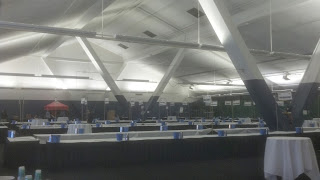
Beyond that, though, the chance to meander around not just for one day but for the weekend allowed good time to learn about nuances, whether it was at Friday night's winter seasonals session with four brewers or at a beer-cigar pairing where non-presenting breweries (I'm looking at you, Epic Brewing) brought their own stashes to share with crowd. And after a weekend of walking through so many treasures, one could treat Saturday not like a rush around the bigger and more spacious tasting area (pictured a few paragraphs above) but a chance to catch up again with brewers and enjoy the scene calmly.
Labels: AC Golden, Avery Brewing, Big Beers, Cambridge Brewing, Fate Brewing, Grand Teton Brewing, Great Divide, Grimm Brothers Brewhouse, Loveland Aleworks, Paradox Brewing, Verboten Brewing, Wiley Roots Brewing

