Monday, January 20, 2020

Once again, the variety and complexity of flavors poured at this year's Big Beers, Belgians and Barleywines Festival - which celebrated its 20th anniversary last weekend in Breckenridge - were awe-inspiring. But this year's masterpiece of a festival from Laura and Bill Lodge felt distinctly like it was not just about what has been produced by some of the most experimental brewers in America but what will be coming from the industry's boundary-pushers for years to come.
New styles, new flavors and new brewers abounded - a trend exacerbated by the number of cutting-edge beer makers who asked to come out and pour this year, adding to the geographical and taste diversity in the hall. And if one walked away with a few predictions as to what more brewers will be doing after tasting their noteworthy brethren, here is what I dare say they would be.
1) Bold adjuncts in stouts are once again on the rise
 If there was a standout beer of the festival, it was Wiley Roots Brewing's Du Hast Cake, a 12% ABV bourbon-barrel-aged German chocolate cake imperial stout that tasted every bit as lusciously desert-like as it sounds - but without a hint of alcohol residue, making it both scrumptious and dangerous. And while pastry stouts have become one of the scapegoats of the "beer doesn't taste like beer anymore" crowd, the only pushback I received when proclaiming this the best beer was from folks who argued Outer Range's Timber from Vanilla Imperial Stout imbued even more awakening flavors.
Indeed, Fremont Brewing's Coconut Edition B-Bomb Imperial Winter Ale and 4 Noses Brewing's Toasted Coconut BMF Imperial Stout proved also how much unique flavor could be added to otherwise big and boozy beers by throwing in something that snubs the Reinheitsgebot. And New Holland Brewing's Dragon's Milk Reserve Oatmeal Cookie tasted of vanilla, cinnamon and brown sugar - not at all of its 11% ABV holdings.
2) Fruit in a sour? How about vanilla, or an Asian soy add-on?
There were, as always, a profusion of both pucker-worthy and smooth-settling sour ales on display at the festival, but there was nothing as remarkable as Purpose Brewing's Itadakimasu #032, which infused the sour rice wine Ponzu into its body and created an entirely new flavor profile. Partly salty and thicker in body than most sours, this is not a beer that will appeal to everyone but absolutely was the gutsiest and most high-risk/high-reward offering of the festival for those willing to drink a beer and mull over it for a significant time, and Purpose owner/brewer Peter Bouckaert (shown below listening to Black Project owner James Howat at a festival seminar) should be commended for his boldness.

Slightly less edgy but no less satisfying was the Language of Origin Sour Ale from Speciation Artisan Ales of Michigan, aged in gin barrels with strawberry, hibiscus, vanilla and lemon. That radical combination melded, and also allowed its ingredients to stand out in alternating turns as it rolled over your taste buds, and it created something that went far beyond the standard definition of a sour ale.
.
3) If going traditional in your sour adjuncts, ignore the typical barrels
Wine, whiskey and other traditional barrels will continue to be used, and for good reason, in aging specialty ales. But Big Beers showed exactly what one could do by reaching further afield for a supply of aging vessels.
Broken Compass Brewing of Breckenridge poured a Port-Barrel-Aged Foreign Export Stout that used tart cherries to impart a pleasantly acidic nose into a sweet and dark body with a pointedness that was lacking from other adjunct ingredients. Meanwhile, Transient Artisan Ales of Michigan put out an Absinthe Anachronism Wild Ale that gave a cherry sweetness to a funky beer without any pucker and made you think twice about its process.
4) The hazy/tropical IPA is about to get doubled
Big Beers is not as much of a showcase for hop bombs as other festivals, but after sucking down 11% ABV imperial stouts for much of the day, you certainly get to know which IPA offerings can break through even the most overused of taste buds.
Oskar Blues Brewery, which produced arguably the most eye-opening beer of 2019 with its Can-O-Bliss Tropical IPA, ramped up the alcohol in its new Double Can-O-Bliss but still managed a creation that focuses on Polynesian fruit without the burn that sometimes accompanies higher ABV. Meanwhile, Outer Range Brewing of Frisco doubled the dry-hopping in its DDH Leave a Trail IPA and made a beer so juicy and bursting with melon hops that it created a new sub-genre: A hazy for people who like big hazies.
5) Clean saisons and gueuzes are the new experimental

For all the giant, genre-expanding beers poured at Big Beers, some of the subtlest standouts remained cleaner beers of Belgian origin that serve as a reminder why the country's influence should be honored so passionately.
Take, for example, the Atom Brewing 3-Year Blend Anniversary Wild Ale, which not only impresses with its smoothness but with the brewery's ability to find just the right examples of beers that meld into creations that are better than their stand-alone origins. Similarly, Referind Brewing's Le Differend Gueze is wonderfully tart but is more a better version of something that's been made for hundreds of years than a new category of the style.
6) Your journey no longer ends at the exit sign at Big Beers
One of the most brilliant strokes the Lodges came up with this year was the idea of raffling off boxes of 12 beers donated by festival participants. That allowed visitors to take home beers that aren't able to be found in their states - and for the non-profit event to raise more money for groups like the Breckenridge Mountain Rotary.
I won one of those boxes (shown below) after buying a lot of raffle tickets to support the cause. I've been working my way through beer from the likes of Mad Fritz Brewing, Side Project and the aforementioned New Holland Brewing, among others. And it's an idea, for tasting and charitable purposes that a lot of beer festivals should consider.

Labels: Atom Brewing, Big Beers, Broken Compass Brewing, Fremont Brewing, Oskar Blues, Outer Range Brewing, Purpose Brewing, Speciation Artisan Ales, Transient Artisan Ales, Wiley Roots Brewing


Wednesday, September 04, 2019
 If the tone of the evening was set by the rows of taster glasses splayed across the bar at the Quandary Grille when guests arrived, the mood was struck by Dave Thibodeau comparing the lifestyle of Durango to that of Nynashamn, Sweden. The Ska Brewing co-founder described outdoor adventures and big beers on the Baltic Sea while pouring five beers that ranged from effervescently sour to dark and pucker-worthy.
The January 2019 Traditional Brewmasters' Dinner was quintessential Big Beers Belgians & Barleywines Festival, combining a dissection of great fermented beverages, the appearance of hard-to-find libations (and the brewmaster from Nynashamns Angbryggeri, who flew in for the occasion) and events that elevate beer. And as tickets for the 2020 festival, scheduled from Jan. 9-11 in Breckenridge, go on sale again this week, it's worth considering why beer-food pairings like these can be so illuminating.
To start with, there is the beer, which is usually pulled from the shelves at the back of cellars where brewers like to keep offerings they open only for special occasions. Nynashamns' contributions included three aged beers and two imperial stouts, one of which it had not served before. Ska rolled out five beers from its sour collection, including its 23rd Anniversary Ale, seemingly showing off what it could do to anyone who dared think of its brewers as "the True Blonde guys."

Then there is the truly well-thought-out pairings of beers that you might suspect would be best enjoyed as stand-alone treats on cold evenings. Ska's Cru d'état, a mixed-culture Brett beer aged in a foeder that hasn't been cleaned in six years, accented the candied bacon on the duck cassoulet toasted pasta (pictured at left) in a way that was unexpected. Its Pink Vapor Stew brightened a parnsip, turnip and beet salad (pictured below) — partly because it shared some ingredients with the leafy feast. Nynashamns' three-year-old Botet Barleywine, aged in Portuguese sherry barrels, cut its own head-turning path with the salad.

Beer dinners are not cheap; this year's Traditional Brewmasters' Dinner, hosted on Jan. 9 by Neil Fisher of Weldwerks and Troy Casey of Casey Brewing & Blending, costs $135. You don't go daily to these events, nor do you go lightly. But when they are done correctly — and Big Beers has a long history of doing them correctly — you leave them jsmarter about brewing methods and culinary choices, as well as a little bit more stuffed than you expected.

Wherever you go to blend beer and food under the guidance of brewers and chefs, just go. Then the next thing you know, you'll be hosting your own such dinners at your house and impressing guests with how much they can learn when they let their taste buds wander.
Labels: barleywines, Beer dinners, Big Beers, Casey Brewing, Great American Beer Festival, Nynashamns Angbryggeri, Ska Brewing, sour ale, Weldwerks Brewing
Tuesday, February 12, 2019

Nick Ison, barrel-aging program manager for Sierra Nevada Brewing, admitted that when it came to formulating recipes, malt, hops and yeast took up most of the space in his head. Then some friends in the brewing industry proposed a modest experiment: Make two of the same beers the same way, with just a variation in the way that the water is treated.
The results were enlightening. And they made for a fascinating, if wildly geeky, discussion at the opening seminar on Saturday morning this year at the Big Beers, Belgians & Barleywines Festival.
You see, it's the seemingly little chemical reactions in water that can have a big effect on the taste of that base ingredient that defines how the more-studied ingredients will affect it. PH levels, total hardness and alkalinity of water impact the acidity, the saltiness, even the metallic scent of a beer. There's a reason some brewers condition their water to match the H2O found in Burton-on-Trent, and it's not for kitsch value.
Of all the properties of water, maybe none are essential to taste as sulfide and chloride. Chloride imbues a malty characteristic on a beer, while sulfide can add the presence of salt. Balancing them is key to creating a drinkable offering.
For his experiment, Ison made a Sierra Nevada Saison, one version with chloride added and another version without it. The difference was fascinatingly clear: The effort with more chloride was bigger-bodied, with a minimal spicy yeast profile. Without the addition, it was softer, with little aftertaste.
Chad Yakobson of Crooked Stave Artisan Beer Project made a similar comparison set - an NEIPA with a typical 1.5-to-1 chloride-to-sulfide ratio, and the same beer with the ratio reversed. The heavy sulfide edition was kickier, more bitter and frankly more adventurous. It was more aggressive, but there was a certain daring that you couldn't forget.

The only person who didn't make two discernibly different beers was Nile Zacherle (talking in the picture above), the founder of Napa's Mad Fritz Brewing who took the most daring route and made his Pale Lager with water sources that he, um, appropriated from two different springs in town. The malt overtook the effect of the water, he noted, surmising that the incoming water source is not as important as the treatment of the water once it all gets into the brewer's hands.
What does this mean? Largely, it means should give you pause to stop and think about what was done to the primary ingredient to the beer before any trendy hops, special yeast or perfectly roasted malt were added to it. These brewers do. And it just may make the difference between creating that beer you can't forget and the one you can't remember amidst all of your tasting.
Labels: Big Beers, Crooked Stave, Mad Fritz Brewing, Sierra Nevada Brewing, water
Sunday, February 03, 2019

Most festivals are defined by the beers poured at them, and this year's Big Beers Belgians & Barleywines Festival could talk about nothing but its offerings and still rank with any festival in America. But after several weeks of reflection following this year's event, it's become clear that it's not just the outstanding pours that defined what may be Colorado's best beer event.
Instead, it was those moments that you keep coming back to that simply don't happen at other gatherings of brewers and beer connoisseurs. And it is worth noting them to explain why the 2019 version of the festival - the third since its move from Vail to Breckenridge - both jumped over the high bar it set for itself and sent the message that it is absolutely as required a place to be as the Great American Beer Festival that takes over Denver each fall.
1) Great Divide's Marriage Beer
The best festivals inspire brewers to make a new beer for them, or to break out of their cellar something they had saved for a special crowd. But when I asked Great Divide owner Brian Dunn - yes, he pours the beer at Big Beers - where his Maple Pecan Yeti that he was serving had been hiding, his answer floored me. It was something the brewery made for an employee's wedding reception, and he thought this would be a good chance to serve the rest of it.
So, it's not just one-offs that are poured at Big Beers, but one-offs made for a very limited crowd that the brewers then think are worth serving again at a festival because of the intimacy and knowledge of that crowd. And the Maple Pecan Yeti, by the way, was one of the highlights of the day - a celebration of blending a sweet flavor into a giant imperial stout that made the beer far more craveable and drinkable than one could have imagined it being.
2) Five minutes with James Howat
If there was a beer better than Maple Pecan Yeti, it was Black Project's Stargate Peach Rye: Nectarine Bourbon, a spontaneously fermented sour ale aged on peaches and nectarines in a fresh whiskey barrel. The beer is both pucker-worthy and succulent in its deep flavors, and one might be left wondering just how something so superior would be made.

But at Big Beers, I wasn't left wondering. In fact, I stood there for five minutes talking with brewery founder James Howat about just how the beer came together, when it would be available at the brewery and how he feels about the growth of beer makers around him in the South Broadway. There was no rush to finish the conversation, and there was no feeling that he wanted to move onto the next beer drinker. When the brewers pour at Big Beers, they interact like they're having conversations with old friends. That may be the best part of the festival.
3) Augie Carton and Nile Zacherle
If you're not from New Jersey, you probably don't know much about Carton Brewing; likewise with your familiarity with Zacherle's Mad Fritz Brewing if you don't live in the Napa Valley. But at Big Beers, two maniacal geniuses who don't sell beer outside their home states are at your beckon call to discuss the leading edge of experimentation in the country.

Carton (far left, above) took time in panel discussions to explain how he makes a beer, Decoy, that approximates the flavor of five-spice roast duck (a fascinating and delicious adventure) and then poured at the general tasting his Gilded Lily Tripel that was made with fresh white truffles. Zacherle (seated next to him, sniffing a beer) wowed the morning kick-off seminar with two pale lagers made with water from different springs that had unique tastes, and he popped out a geranium-thyme kolsch that made you want to forage for your own ingredients to add to traditional beers.
4) The "Lines"
At one point early in the commercial tasting, a friend directed me to Casey Brewing and Blending for its Jammy Sour Ale, a blackberry-added, oak-barrel-aged collaboration with Side Project that had a full and bright body. It was the biggest line I waited in all day - a full 10 people long.
Later, I stood in a nearly similarly sized line for the brilliant grape-infused beer at Liberati Osteria & Oenobeers when I decided that I was thirsty enough to step out and go directly to the front of the non-existent queue for Side Project's tart and intriguing Punchdown Pinot Noir Wild Ale. And so it went at a festival where your choices ran the gamut from brilliant brewers to very good ones, all of whom had something to offer that was great.
5) The Advice

A friend whom I attended the show with informed me that Bell's Barrel-Aged Third Coast Old Ale Barleywine was as perfect a beer as he'd tasted; a sentiment I largely agreed with after I tried it. And it was a co-owner of Grimm Brothers Brewhouse who insisted I try his Feisty Fearless, a Fearless Youth dunkel aged in Feisty Spirits barrels that transformed into a batch of orange-peel-sotted, slightly acidic goodness.
But throughout the day, I would set my beer down at a table to take notes, and whoever happened to be there segued naturally into conversation about what I was drinking, what they were drinking and what some of the hidden gems of the festival were. That's just the feeling in the Big Beers crowd. And through these pieces of advice, I found some of the other best beers of the festival, such as Dry Dock Coconut Belgian Dark, /Founders KBS 2018 and Kane Driftwood, an imperial brown brewed with molasses and maple syrup and aged in brandy barrels.
6) The Community

This year, the conversation was both serious and mournful at times among the attendees, as Big Beers co-founder Bill Lodge had lost his daughter, Megan, in a car accident just weeks before. And the word spread quickly through the crowd that what we all wanted to do was to help in this terrible moment in the only way we knew how - by contributing to a fundraiser for Eagle Valley High School's speech and debate team, which was a passion of Megan's, in honor of both her and Bill and Laura Lodge.
That's what a beer festival can be at its best - not just a random gathering of drinkers but a community of people who are there for the sharing, for the experimentation and for the human emotions that go beyond enjoying a great beer. And that's why Big Beers, Belgians and Barleywines proved again that it's an experience much more than it is just the sum of its amazing tasting offerings.
Labels: Bell's Brewing, Big Beers, Black Project, Carton Brewing, Casey Brewing, Dry Dock Brewing, Founders Brewing, Great Divide, Grimm Brothers Brewhouse, Laura Lodge, Mad Fritz Brewing, Side Project Brewing
Saturday, January 05, 2019

The Big Beers Belgians & Barleywines Festival has gone through some very noticeable changes in recent years (like moving from Vail to Breckenridge in 2017) and some very subtle ones. But it's those seemingly minor tweaks that this year have added up to making this officially the festival for people who don't just want to drink a lot of beer but who want to sponge up knowledge about the craft at the same rate their liver is processing alcohol.
That's not to say the nationally lauded annual event, now celebrating its 19th year from Jan. 10-12, hasn't always gone the extra yard to imbue knowledge upon its participants. It's always been marked by early-morning seminars on experimental brewing styles, multiple events pairing beer with food and cigars and brewers who are omnipresent at the commercial tasting to explain just how they incorporated an experimental yeast or ingredient.
But those seminars (pictured below) are getting more technical as they are getting more popular - a reason that organizers Laura and Bill Lodge decided for the first time this year to sell $15-$20 tickets to each of the gatherings, since the tracks grew so crowded last year that crowds couldn't fit into the rooms. And this year's slate of 12 talks goes to depths beyond even many of the great seminars in the past, including the start-of-the-morning gathering on Saturday in which Crooked Stave, Mad Fritz and Sierra Nevada delve into the impacts of water on beer by making the same brew with three different water sources.

Laura also wanted to take the welcome reception to a new level - this time without adding the cost of tickets to a beer-and-food pairing that had grown costly to the overall event. So, the 2019 reception (noon to 1 p.m. on Friday at Beaver Run Resort) upped its number of brewer participants to four serving two beers each and replaced the high-end pairings with a nacho bar, so that beer geeks have time to savor new flavors and talk to the men and women who create them.
"I really wanted to do a formal, you've-arrived entrance," Laura told me. "We're really looking to, I guess, polish it up."
To be sure, Big Beers didn't need much polishing. The commercial event alone puts this among the best beer festivals nationally, with the likes of Adam Avery or Sam Calagione pouring rarities and barrel-aged beauties and explaining their qualities to lines of people that stretch sometimes 10 long instead of the around-the-corner queues that can mark the best breweries at Great American Beer Festival.

"It's a really great feeling to see the community coming together in that way," Laura said.
What's really begun to separate this festival from others in recent years is the affiliate events happening around Breckenridge as it occurs. Yes, those include special tappings and food pairings.
But there's also a workshop on Belgian beers, an educational discussion on hazy beers and informational pourings and tappings focused on fermentation, blending and randalls. Hell, there's even a special event on low-gravity beers, which is the equivalent of the NFL directing a seminar on the grace and beauty of soccer.
I'm not saying that you'll be so steeped in learning that you won't get drunk at Big Beers. You're at 9,600 feet above sea level, the first seminar on Saturday begins at 9 a.m. and you're drinking beers no less than 7 percent ABV, with the exception of a few lower-alcohol Belgian styles. You're going to feel it, even if the drunkenness is just a byproduct of your activities rather than a goal.
But this festival has gone well beyond a little bit of learning and a lot of beer. It's like an upper-level college course on what makes great beer as great as it is, with the benefits of your being able to taste every bit of that as you are steeping yourself in knowledge. And that's why it's become, in some ways, the absolute must-hit beer event of the year in Colorado.
Labels: Avery Brewing, Big Beers, Boston Beer Co., Breckenridge, Crooked Stave, Laura Lodge, Mad Fritz Brewing, Sierra Nevada Brewing
Thursday, August 09, 2018

Just one sip of Epic Brewing's Lupulin Burst leaves you no doubt that you are putting an entirely new style of beer into your mouth. It isn't just that you are looking into a glass of murky, almost soupy liquid. It's that what flows over your tongue is so full of pineapple and mango, so juicy and yet still so crisp in its hop backbone, that you can't categorize it as much as you can sit and admire.
Well, actually now you can categorize it - it's a hazy IPA, a strange-looking riff on America's contribution to the increased bitterness in worldwide ales that was mocked at first as the product of lazy brewers, then slowly grew an acceptance as it developed an increased following. This year, the Brewers Association created a category for Great American Beer Festival judging called "Hazy or Juicy IPA," and it received 414 entries - far more than traditional category leader American-style IPA and more than enough to tell haters of the style that their time was done.
But the realness of hazy IPA - and its true beauty - lies in more than its mass proliferation in the craft-beer scene. After two years of evolution, it lies in the fact that this style is no longer an off-shoot of IPA so much as it is something truly different. At its best, the beer represents an outpouring of tropical flavors that even the boldest traditional IPAs have only hinted at in their aroma and flavor. It signifies a blending of bitterness and softness that once might be considered unthinkable, as well as refreshment in a way that aggressively flavored beers have never presented.
And it's time to stop nitpicking, to quit complaining and just to give this evolutionary and revolutionary style its due, because it's not going away.

Fisher, who is one of the true pioneers of the style, began making juicier, more approachable IPAs because he, like many beer geeks, was turned off in the late 2000s by the rush to produce triple IPAs and other such beers that exceeded 100 IBUs. He estimated at the Big Beers seminar that 95 percent of the brewers making hazy or New-England-style IPAs were brewers producing less than 20,000 barrels a year who don't have labs set up to record earth-shattering IBU levels in their products.
Much of the flavoring in these hazy IPAs comes from dry-hopping, giving them both a more appreciable nose and a more prevalent taste of these citrus hops, whether they be Mosaic or Citra or El Diablo. At certain rates of dry-hopping, you actually lower the IBUs in beer, making it less lastingly bitter while blowing up the flavor of the lupulin and letting it be so bold as to bend genres on the juiciness that one can pack into beer.
Weldwerks seemed to introduce Colorado to the idea of hazy IPAs through its Juicy Bits, a beer that is light on bitterness in the nose but heavy in pineapple in the taste, ultimately finishing smoothly while bombarding you with flavor. And quick to the party was Outer Range Brewing of Frisco, creating palate pleasers like In the Deep Steep Double IPA, a beer that offers both huge citrus and big hop acidity lingering on the back of your palate, producing oddly soft and tropical tones that leave you longing for more.
But if not every brewery was quick to jump on board with the trend, several have made up for lost time in just the past six months with beers that push the envelope even further away from sharp bitterness and toward an almost Hawaiian burst of flavors that celebrate the diversity of hops.

Great Divide Brewing, which seemed slightly conflicted on how far it wanted to dive into the haze pool with its Heyday IPA introduced in April, went full-in this summer with its Hazy IPA, to great results. This presents a citrusy, lush hop that never fails to finish its introduction with a back hop bite, and it all comes at you so smoothly that you'll want to drink all night.

Still, some of the finest hazy IPAs in Colorado come from smaller brewers who have thrown caution to the wind and produced such genre-redefining examples of the beer that they can not be ignored.
Urban Lumbe
 rjack IPA, from Lakewood's Westfax Brewing, resembles hop soup but boasts both sweet and full pine and satisfies in every drop.
And Colorado Springs' Cerberus Brewing has crafted an Elysium IPA that is slightly more bitter on the back bite than some of its stylistic brethren but envelops your taste buds in mango and guava on the way there such that you feel you've been feasting on something Polynesian with just a hint of pine needles as the aftertaste.
There undoubtedly will be more breakthroughs and more notable, crushable hazy IPAs to come. But the best way beer drinkers can prepare for them is to accept that this is not just some bastardization of the IPA - unlike, say, the milkshake IPAs that have earned their own level of hell in Dante's Inferno - but a turn toward a different flavor profile that opens up a new storehouse of tastes in craft beer.
This is worth celebrating.
Labels: Big Beers, Cerberus Brewing, Epic Brewing, Great American Beer Festival, Great Divide, hazy IPAs, Outer Range Brewing, River North Brewery, Weldwerks Brewing, Westfax Brewing
Friday, March 09, 2018

In the chicken-or-egg scenario, the answer is clear: Craft breweries began to grow exponentially before craft coffee roasters did. But now that the local business segments are on similar trajectories, there may not be a better partnership in the alcohol industry.
What's more, coffee beers have become one of the most studied and talked-about trends among the many booming styles in craft beerdom. From a panel discussion at January's Big Beers, Belgians & Barleywines Festival to Saturday's upcoming Cool Beans Beer & Coffee Festival at Ratio Beerworks in Denver, the offerings are being pored over as much as they are being poured — and beer drinkers are the beneficiaries.
Once a pairing that seemed only to be made straight up with stouts and porters, coffee is appearing now in everything from lighter ales to sours. And brewers are adding lactose, dextrose and spices to make your coffee beer feel like it too is served with sugar and cream, or with the appropriate ingredients to label it Mexican Coffee.
The idea of adding coffee to beer is not a new one, noted John Holl, editor of Craft Beer & Brewing magazine at the panel he led at Big Beers in Breckenridge. But the way it's being used now make shock the sensibilities of those brewers who first experimented it with it in the early days of what then was called the microbrewing movement.

More locally, Epic Brewing, long known for the coffee it blends perfectly into its Big Bad Baptist barrel-aged imperial stout with cocoa nibs, has diversified its offerings with its Son of a Baptist and its Coffee Cream Ale, not to mention offshoots like its ridiculous Triple Barrel Big Bad Baptist. And while the brewery's earned its reputation by going for the extreme, there may be no beer in Colorado in which the coffee owns the flavor quite so much as the deceptively smooth and drinkable Son of a Baptist imperial stout.
Oskar Blues also has brought alcoholic life to the party with is Java Barrel-Aged Ten Fidy, which uses the barreling and the coffee to mellow the beer in a slight but necessary way and give it a sweet, surprisingly easy body for a 12.9% ABV beer.
And then there are the wide range of beers that are adding coffee to their spicy Mexican stouts, creating an even more complex version of a beer that tastes already like a distinctly foreign drink. Crazy Mountain's Rum Barrel Aged Spanish Coffee Stout is a prime example of this.
Not everything blends seamlessly with coffee, to be sure. Jordan Schupbach, Epic director of brewing operations, noted during the Big Beers panel (pictured above) that he tried to brew a coffee beer with a lager yeast and it didn't turn out. Left Hand brewhouse manager added that he used a light-roasted coffee with a more light-bodied amber ale and "it just turned out to be not a good beer."

 And brewers continue to push the taste barriers still, finding offerings that pair with coffee in newer and more intriguing ways.
Ratio's festival, running from 10 a.m. to 1 p.m. Saturday, will feature a coffee session IPA, a coffee chocolate rye scotch ale and a whiskey-barrel-aged Irish coffee American strong ale. The event, which aims to show off how many ways coffee can blend with beers to create new tastes, is as much education as it is imbibing.
Sure, the now-old-fashioned trick of blending dark coffee taste with a beer that also is as dark as night still works too. One need only try the Spaghetti Western Imperial Chocolate Coffee Stout, a collaboration between Prairie Artisan Ales and Italian beer maker Brewfist, to sense that.
But coffee beers are growing and diversifying, just as the coffee-roasting industry is. And that's a dark area worthy of having light shone onto it.
Labels: Big Beers, Brewfist, Carton Brewing, Coffee beer, Crazy Mountain Brewing Company, Epic Brewing, John Holl, Left Hand Brewing, Oskar Blues, Prairie Artisan Ales, Ratio Beerworks
Tuesday, January 09, 2018

Tiramisu, French toast, crickets: These were the flavors one can't forget from the 2018 Big Beers, Belgians and Barleywines Festival.
The collection of roundly amazing beers — I poured just one into a dump bucket during the four-hour tasting — was again a master study on barrel aging, hearty hopping and using bugs to bring the right level of tartness to beer. But this year, more so than in past years, it also felt like a grand experiment on the adjuncts that can push beers beyond their normal limit. And what a wonderful palate-wrecking experience it became.
There were desert beers, including a New England-style IPA made with Betty Crocker cake sprinkles (Thank you, Outer Range Brewing, for keeping the cake flavor light). There were sours that relied on the presence of multiple fruits to create new flavors. And by the time you got the gumption up to try Epic Brewing's Chapulin Gose, you literally found yourself saying: "I like the beer, but I'm not picking up the flavor of the crickets or the agave worm salt in here." And, yes, you were bummed.
So what were the biggest takeaways of the festival? Here's a few:
1) The bolder the range of flavors in big beers, the more they stood out.
Certainly, there were the big and dangerous classic bourbon-barrel-aged imperial stouts there. Loveland Aleworks had a 2015 version that was incredibly smooth. River North Brewery offered up a whiskey-barrel-aged English-style old ale that was so warming it set your insides ablaze.

But the real head-turners were gems like Cellar West Artisan Ales' Farmers Breakfast, a farmhouse-style imperial breakfast stout that was re-fermented in bourbon barrels with maple syrup and offered a fascinating melange of flavors that somehow became French toast in a glass. Or there was Epic's Triple Barrel Big Bad Baptist, which not only featured imperial stout aged in whiskey barrels but had barrel-aged coconut that made this spring to a new vibrancy and overshadow its high ABV.
2) Spices are on the rise as adjuncts, thankfully.
You saw this trend where the beer advertised it blatantly. Crazy Mountain's Rum Barrel Aged Spanish Coffee Stout, for example, was rendered unforgettable by the fact that the Denver brewery used Mexican chocolate to make what could have been a heavy beer burst with flavor.
But the trend appeared even where you were least expecting it, and it was pleasing. Verboten's Tiramisu Little Nonsense had a surprising shock of Saigon cinnamon that left you with hope that chefs can make deserts like this too. And Intrepid Sojourner Beer Project's Barrel-Aged Imperial Turkish Coffee Stout added even more Middle Eastern spicing than its regular-strength version - and took your palate to a far-off place.

If there was a single beer of the festival, it was this Teller County brewery's Divide Ethos, a spontaneously fermented wild ale that felt like a kicked-up saison, with the bugs pinching your tongue with just a bit of sour and a whole lot of wild. The fact that it was the brewery's first coolship beer speaks even more to its ability to create new flavors.
Paradox was a big winner last year as well. It doesn't get as much attention as some of Colorado's other great wild-yeast-ale makers, partly because of its out-of-the-way location west of Colorado Springs. But it sure should.
4) It's the fruit and unusual add-ins, as much as the bugs, that are propelling stand-out sours.
Maybe Modern Times pushed the sour envelope a little too much with its One Million Tomorrows, but by mixing a ton of blueberries and raspberries into its wine-barrel-aged saison, it created such a complex flavor that you were willing to forgive the brewery.
No forgiveness at all was needed for Three Barrel's Hermano X, a lambic made with coriander, orange peel and three types of pepper that was tart enough to wake up your taste buds and your mind. And if Caution Brewing's Mazu Sour Belgian Golden — made with orange peel, coriander and cardamom and aged in red-wine barrels — wasn't the best sour on the floor, it may have been the most unique.

5) More significantly aged beers are needed.
Two-and-three-year-old beers were everywhere. But the joy of sipping Stone Brewing's 2007 Old Guardian Barleywine and enjoying its sweetly aged body even as the hops diminished was a short-lived pleasure because it stood so alone among the largely newer beers on the floor (save for Sam Adams' 24-year-old Triple Bock).
There wasn't much one could have left wanting from the festival. But 10-year-or-older beers would have been fun to try more frequently.
Labels: Big Beers, Cellar West Artisan Ales, Crazy Mountain Brewing Company, Epic Brewing, Intrepid Sojourner, Loveland Aleworks, Modern Times, Paradox Brewing, Stone Brewing, Three Barrel Brewing, Verboten Brewing
Tuesday, January 02, 2018

No change that Laura and Bill Lodge will make to the Big Beers, Belgians & Barleywines Festival will be bigger than last year's move of the event from Vail to Breckenridge after 17 years in its original home city. But that doesn't mean the resettled festival will stop trying to find new ways to entertain its crowds during its second year in its new home.
With one of Colorado's best celebrations of yeast and hops just two days away (the first events begin on Jan. 4, while the commercial tasting is set for Jan. 6), it's worth taking a look at what will be different about the festival this year. And it's worth reiterating that if this all sounds good, tickets for the main event remain available.
1) The Falling Rock Lounge
One of the biggest aspects that was missing from the event last year was the central gathering spot, a role that the Fireside Lounge in the old Vail Cascade Resort filled for years. Festival organizers, in conjunction with Denver's oldest beer bar, are changing that in 2018.

The "Pop-Up Falling Rock" will be a temporary bar with a Chris Black-curated beer list that will occupy the open space near the arcade and the hot tubs on the second floor of the host Beaver Run Resort & Conference Center. Hotel officials will pile soft furniture in that space and signs around the resort will direct people there, making it likely this will be the spot to relax when seminars and the main tasting are not in progress.
2) Bigger Seminars
Last year, afternoon seminars were held in adjoining spaces that held just 35 people each, leaving some people unable even to sniff topics like how to brew with exotic fruit and vegetables.
This year, the Lodges will combine those two rooms into one seminar area and double the space, while moving some of the other talks to the Base 9 Bar on the bottom floor. There will be four seminars at 12:05 p.m. and another four at 1:15 p.m. And one of the defining characteristics of the event - being able to learn more about beer throughout the day in talks that feature a fair amount of tasting as well - will be open to more attendees.
3) A Wider Range of Seminars
Saturday morning's schedule begins at 9:30 a.m. with a talk on the timely and controversial topic of New England IPAs from a panel that includes Colorado's best makers of the style, including Neil Fisher of Weldwerks and Lee Cleghorn of Outer Range Brewing. But while that's sure to attract beer geeks by the kettle-ful, Laura Lodge promises other choices that will welcome people of all interests.

If you want to learn to pair beer with spicy foods, there's a seminar for that. If you want to enjoy a beer while doing yoga on Saturday morning, there's an opportunity for that. And if you really want to work with random strangers to try to pair four beers and four foods, there's a different break-out session that features that too.
"I think sometimes people think Big Beers is for people who are just in the industry or super-savvy," she said. "I think the novice can learn as well."
4) An App for Festival Planning
Festival organizers are working with Digital Pout, which has created an app to help people find where breweries are on the floor plan, what they're pouring - and when a beer runs out. Thus, if you're one of those folks who wants to spend much of your 3-1/2-hour tasting looking for rare and aged beers, you can map out beforehand where they are and know when you should redirect your adventures in mid-festival.
5) A New Entry for Attendees
One of the bugs of the first year at Beaver Run was the bottleneck of VIP and regular-ticket attendees backed up at the same entrance point on the third floor, leading to a slowdown getting in and to complaints from brewers on the first floor that it took a long time for many attendees to find them. This year, the early crowd will go in at 2 on the first floor and the later crowd goes in at 2:30 on the third floor, leading to less congestion and more spreading of entrants across the tasting space.
6) New Breweries ...
Laura Lodge recalls getting a call from experimental brewer Cellarmaker Brewing of San Francisco last year asking if they could come and pour their beer at the 2018 festival. Within 15 minutes, she got a follow-up call The Rare Barrel, an equally sought-after Berkeley brewery, inquiring whether it too could come and pour.

"We're starting to see some really cool, innovative folks who may not have experienced Big Beers before but want to be here now," she said. Expect this trend to continue and grow.
7) ... And More Breweries
After opening the festival to 140 breweries last year, Big Beers will welcome around 150 this year. The increase isn't terribly impressive, but the way that number is growing is.
With a waiting list of dozens of participants, Lodge told brewers they were welcome to share their table if they wanted with some of those breweries waiting in the wings. She expects at least 10 to do so, creating both a growth in the number of breweries on the floor and the partnerships between those beer makers.
"I believe it's the true spirit of craft beer," she said.
And that's one more reason this festival can't be missed.
Labels: Big Beers, Breckenridge, Cellarmaker Brewing, Falling Rock Taphouse, Festivals, Laura Lodge, Outer Range Brewing, The Rare Barrel, Weldwerks Brewing
Thursday, December 21, 2017

Staring at the calendar, you realize that the big day is now only two weeks away.
That's right: Big Beers, Belgians and Barleywines Festival begins on Jan. 4.
While some of you may have visions of sugar plums dancing through your heads, Laura Lodge has visions of rum-barrel-aged sugar plum saisons being poured in neat lines over two floors of Beaver Run Resort in Breckenridge on Jan. 6 at a tasting that caps three days of festivities. And, unlike last year, when she was heading into a new town for the festival for the first time in 17 years, she knows this year what to expect from that town - and is really excited about the opportunities it presents to enhance what is already one of America's greatest beer festivals.

"Last year I spent a good portion of my summer and fall in Breckenridge trying to figure out what businesses wanted to be a part of Big Beers and learning how we would fit in," said Lodge, who runs the festival with her brother, Bill, in addition to running her company that works with hotels and resorts to establish craft-beer programs. "This year I already know who some of the key players are, so I am starting to meet some of the people behind the scenes."
Big Beers is an event worth getting ready for weeks early, even with two major holidays standing before it on the calendar, because it is such a unique gathering of brewers. Some 150 beer makers and international beer distributors will be pouring beers that are 7 percent ABV or above (plus a fewer lighter Belgian styles) and typically foisting onto you some of their rarest offerings aged in barrels right alongside their more common double IPAs and imperial stouts.It all will be done in an intimate setting where the person who came up with the crazy idea for the beer in your hand is the one explaining it to you as it cascades into your glass.
And this regal tasting happens only after a day of seminars that begin before 10 a.m., offering those wanting to dive into the art of brewing, blending and barrel-aging beer a chance to get unusually academic - while sipping on a barleywine around the same time that others are eating Cheerios.

From 2000 through 2016, the Big Beers festival made its home in Vail, an impressively scenic and special town but one without much of a grounding in the craft-beer movement that's swept over Colorado. Lodge moved the event because the former host hotel was in the midst of an extensive renovation, and what she found was a replacement home that added more local touches and more character to the festival.
Now, instead of attendees just having the option to get tickets to the three beer-pairing dinners that occur on the Thursday and Friday nights prior to the big tasting, they can hit up tappings, beer/food pairings and brewery-sponsored concerts around the village. It's become more like a miniature Great American Beer Festival, except for the mind-blowing fact that Big Beers often doesn't sell out of tickets (and still hasn't for this year).
There are changes coming to this year's festival because of things that Lodge learned at the 2017 event, and I will detail some of those as the event gets closer. But the biggest difference as the clock winds down on preparations for Big Beers 2018 is that the sense of transience that surrounded the event at this time last year has morphed into a sense of permanence and a feeling that now, more than ever, it's really home.
"I think what we're seeing here is a shift based on the community the event is held in," Lodge said recently. "I think we're seeing Breckenridge shine because they have a more developed beer culture."
Labels: Big Beers, Breckenridge, Festivals, Laura Lodge
Thursday, November 23, 2017

Wandering through the third floor of the McNichols Civic Center Building last month during Denver Rare Beer Tasting was the equivalent of being trapped in a black hole. Everything being poured was heavy and dense, and no light could shine through any glass.
The biggest difference was, however, that this was an experience you enjoyed so much that you could even begin to pick up subtleties in the booth after booth of the 16- to 19-percent-ABV beers in which you were imbibing. And through that, you could see how far the craft beer industry has come in the past 10 years.
It's not that imperial stouts weren't tasty circa 2007. But those that pushed 10 or 11 percent ABV at the time tended to be beers whose alcohol content was readily apparent. A big beer often brought with it a big, boozy taste. And there was a limit to how many of those you could drink.
Today, however, you can find a beer like Avery Brewing's Black Eye, a 3-year-old rum-barrel-aged imperial stout that grew to 18.8 percent ABV by the time it hit drinkers' glasses last month. Its body was bursting with depth and darkness, but it also was shockingly smooth, using its enormous malt base to cover any residual alcohol burn. It not only was a great beer; it was damn near dangerous.

At just that one event, however, you could also find River North Brewery's 18 percent Vicennial Shadowman, which presented a huge mouthful of almost sooty dark malt that was shockingly drinkable. There was WeldWerks' Medianoche Reserve, which weighed in at 13.5 percent but added an astounding smoothness to its underlying cocoa punch. And even a beer like New Holland Brewing's "Dragon's Milk: Michigan's Winter" added a little burn to its 16 percent body, but not enough to overshadow a bittersweet coffee palate that made you want more.
It isn't just at specialty beer festivals that you find these big-bodied gems, either. Taprooms across the state are featuring experimental and seasonal creations of substantial girth right now, much in the way that virtually every taproom is trying its hand at a New England-style IPA.
So, you can actively seek out a hammer of a beer like Verboten Brewing's Little Nonsense, which packs heavy flavors of both bourbon and vanilla from its barrel aging and manages to be every bit as tasty as it is aggressive.

Or you can find a hidden treasure like Goldspot Brewing's Black Whiskey River Imperial Stout. At 10.5 percent, it's almost a light beer compared to some in this group, and its body isn't as pelting with heaviness as others. But after sitting 5-1/2 months in a Laws Whiskey House barrel, it takes on a lot of warming whiskey flavor but still allows the rough-hewn, slightly mocha edge of the body to take center stage.
And let's not forget, the incomparable Big Beers, Belgians and Barleywines festival - scheduled for Jan. 4-6 in Breckenridge - will be another showcase for the creativity in the imperial stout world.
The joy in drinking these beers is both complex and simple. The flavor profiles they raise bring up tastes ranging from sweetness to heat to bitterness, and picking them out of the big, meaty body is both challenging and satisfying. Yet there is a simplicity in enjoying the idea of a brewer tossing everything they have into one recipe, rolling the dice and letting the experiment end in a boozy, warming toast to their gutsy resolve.
While co-hosting American Craft Beer Radio a couple of weeks ago, I asked Wynkoop head brewer John Sims if I was crazy to think these beers were getting smoother and easier to drink even as they are getting bigger - while we were enjoying his Captain K's Final Daze, an imperial honey brown that offered both depth and a sweetness that was anything but cloying.
He told me that I was not nuts and that brewing techniques have evolved so much in the 24 years he's been in the industry that the methods for making and aging beers have taken off some of their alcoholic roughness while accenting the malts and the occasional additives even more.
To that, I say cheers. And as the nights turn colder, I plan to raise more pints (or smaller servings) of imperial stouts that will intoxicate me as much with their taste as they will with their alcohol content.
Labels: American Craft Beer Radio, Avery Brewing, Big Beers, Denver Rare Beer Tasting, Goldspot Brewing, imperial stouts, New Holland Brewing, River North Brewery, Verboten Brewing, Weldwerks Brewing, Wynkoop Brewery
Wednesday, November 01, 2017

Each time a new brewery enters the Colorado market, one must ask: "What are it bringing to the local beer party, and how does it change the beer scene here?"
But with Zymurgy Magazine's 24th-ranked brewery in America making its full-time distribution debut in the state just this week, the more appropriate question seems to be: "What more is there to come?"
Surly Brewing of Minnesota has earned its national reputation for pushing taste boundaries and disregarding traditional style definitions. It's the most well-regarded brewery to emerge from the Gopher State, and it draws crowds at events like the Big Beers, Belgians and Barleywines festival, where its experimental beers are on offering here for at least one day a year.

Just to be clear, the trio of Surly offerings now available at bars and liquor stores are quality beers. Furious greets you with a piny bite but leaves without residual bitterness. Hell is classic German lager, with just enough sweetness from its Carahell malts to make it stand out. And Xtra-Citra is arguably the jewel of the bunch, a melon-forward, full-mouthed pale that bounces between citrus and tropical flavors and leaves you wanting another — which is appropriate, since it's only 4.5% ABV.
But anyone who has tasted a creation like Surly's Five — its fifth-anniversary Brett dark ale that was aged in red wine barrels and was bursting with the flavor of tart cherries — knows the brewery is more than crushable post-hike beers and top-notch IPAs. This is a brewery, named for owner Omar Ansari's angst at not finding good beer options in his state before he decided to open his own place in 2004, that can present flavors that only a minimal number of Colorado beer makers are creating. And you just want the chance to pick those up locally.

So, welcome to the state, Surly and your tasty creations. And please don't leave us surly about what Minnesotans have that your new friends in Colorado can't yet get.
Labels: Barrel aging, Big Beers, IPA, lager, Pale Ale, Surly Brewing, Zymurgy
Friday, January 20, 2017
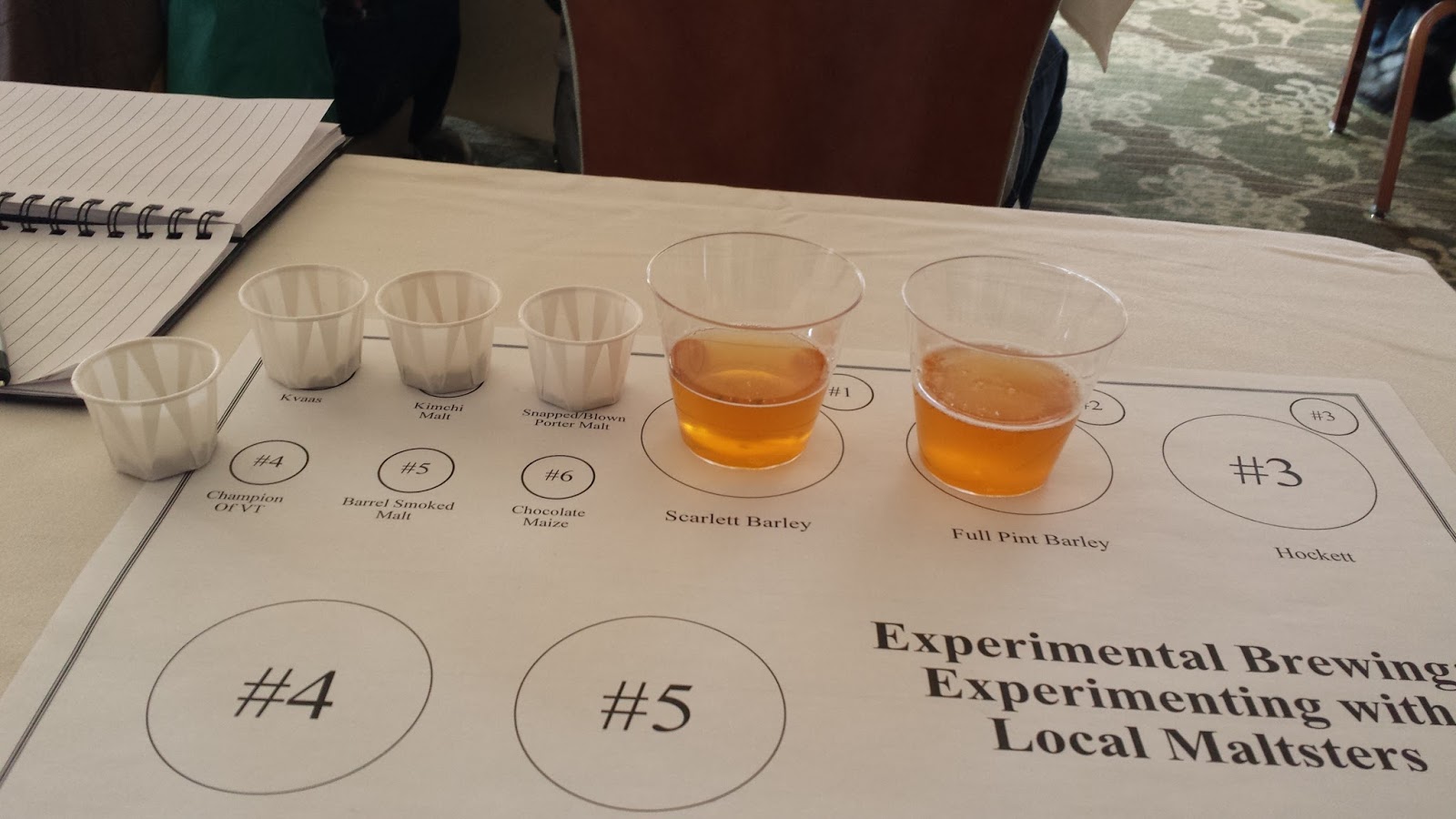
In a small facility in western Massachusetts, Andrea Stanley is doing everything she can to come up with varieties of small-batch malt that are going to differentiate the small-batch brewers who use them. Sometimes that involves dipping back into brewing history to revitalize brown porter malt. And sometimes that means going where no one thought beer makers would want to go — like soaking malt for two weeks in a crock pot with kimchi to invent a whole new flavor.
What Stanley, owner of Valley Malt, and a small number of other craft maltsters — there are 44 operating in the United States now, with 26 more malt houses under construction — are doing is taking back an industry sector that largely is in the hands of big corporations. Craft maltsters produced just 0.4 percent of the supply in North America in 2016. Then again, that's about the percentage of American beer that craft brewers were making in the early 1980s as well.
And while big malt houses will churn out exciting products every once in a while, they are not coming up with the Kvaas malt or bourbon-barrel-smoked malt that Stanley is. And most are not offering single-variety malts like Colorado Malting Company of Alamosa, experimenting with the flavors that a lone crop can give to a beer.
"This is the way that things are moving," said Chad Yakobson, the founder of Crooked Stave Artisan Beer Project who recently worked with Casey Brewing and Blending to make two versions of their Von Pilsner with two different malts and produced strikingly different flavors. "Malt is beer ... So, without it, what do we have?"
Stanley, Yakobson and others gathered at the recent Big Beers, Belgians and Barleywines Festival in Breckenridge for a panel discussion on experiments with local malt. The talk was eye-opening in regard to the possibilities of flavors not yet achieved by American brewers through the use of new varieties of one of the four main ingredients (with water, hops and yeast) that go into a beer.

Jason Cody, president and CEO of Colorado Malting Co., explained that he worked with the ever-experimental Three Barrel Brewing to make three varieties of the same ale, each with their own strain of single-variety malt — unusual in an industry that relies heavily on blended malt. And the samples of the beers they poured at the seminar were wholly unique - one light and jasmine-tinted, one traditionally earthy and a third almost flowery.
"This was a huge eye-opener for me," said Will Kreutzer, brewer and manager of the Del Norte beer maker, who works closely with father-in-law owner John Bricker (both pictured with Cody, above).
Yakobson's two Von Pilsners — one with Weyermann Pilsner malts and the other with Leopold Brothers floor-malted barley — also felt like different beers. Weyermann malts made the beer feel exceptionally clean and seemed to accent an airy quality, while the Leopold Brothers malt gave its offering qualities that were sweeter and somewhat chewy.
Stanley didn't bring beer samples but presented the malts almost as a breakfast supplement. (This, after all, was the 9:30 a.m. seminar on Saturday of the festival.) And while the kimchi malt was the most vibrant and palate-startling of the bunch — even if it would be difficult to pinpoint exactly what style of beer would benefit from its characteristics — varieties like the Kvaas malt, made from rye, gave hints of the bready, almost historical flavors that could be brought out with such new efforts.
"Are we going to transition all of our beer to be flavored with kimchi malt? The answer is obviously 'no,'" said John Mallett, the director of operations for Bell's Brewery who was presenting with Stanley. "But I love that malts like that are being made."

Craft brewers have used hops, yeast and additive ingredients to create new flavors and whole new styles of beer over the past 25 years. So, it's wonderful to see that by tweaking what is arguably the most staid of beer's primary ingredients, they may be about to push the flavor profile of this traditional beverage that much further.
Labels: Bell's Brewing, Big Beers, Casey Brewing, Colorado Malting Company, Craft malting, Crooked Stave, Leopold Brothers, Three Barrel Brewing
Monday, January 09, 2017

Colorado's best themed beer festival found a new home in Breckenridge after 16 years in Vail and, frankly, found a new energy. There was vibrancy throughout beer bars in the town and vibrancy throughout the Beaver Run Resort, where most events were held. And brewers clearly tried to raise their games with the beer they were pouring — and, in many cases, succeeded.
Here, then, are four big thoughts about what took place over the past four days, both in regard to the beer and in regard to the good folks who were ensuring the beers were poured.
1) The new wave of imperial stouts will redefine the style.
 It may sound obvious, but you can't drink Russian imperial stouts for three-plus hours without them beginning to taste a lot alike. That is why the growing number of brewers adding unique ingredients to these creations — ingredients that go beyond the coffee and chocolate that brewers like Epic already have pioneered so well — were the ones most often turning heads at Big Beers.
Station 26 Brewing stood at the head of the pack with its German Chocolate Bourbon Barrel Aged Dark Star Imperial Stout, which felt every bit like the desert it was named after and flowed so easily at 13 percent ABV that you didn't know whether to be enthralled or frightened. And very close to that creation in its palate-pleasing level was Weldwerks Brewing's Barrel Aged Mexican Achromatic, which bubbled over with cinnamon and vanilla and made Mexican coffee weep at what it could be with hops and barley added.
2) The barrel can make all the difference.
With more breweries trying more ways to age their beer in barrels, the possibilities are almost limitless at the flavor profiles that can come from the experiments. But not every decision to throw a beer into a barrel is a solid one — a truth that could be seen in the number of barrel-aged saisons from very good brewers that felt listless and undefined. (A major exception was the Old Order 6 bourbon-barrel-aged imperial black saison from Solemn Oath Brewing, whose malt backbone allowed the beer to stand up against the barrel).
But there were brilliant decisions with barrels too. Paradox Beer's Trois Ans Anniversary Ale, aged in Spanish Cedar barrels, gave off a wonderful blend of tart and smoky-wood complexity and made you stop to think about what you were tasting. Similarly, the choice by Grimm Brothers Brewhouse to age its Magic Mirror imperial koltbusser in oak barrels turned an adequate malt monster into a tart and challenging beer that showed off its honey and molasses in new and vibrant ways.
3) More chai beers and imperial IPAs are needed.
Two years ago, tiny Altitude Chophouse had maybe the beer of the festival with a chai-infused dunkelweizen, making one ask why more breweries don't use this palate-enlivening ingredient. This year, New Holland Brewing absolutely startled with its Dragon's Milk Reserve Vanilla Chai, which was a full-throttled expression of how bold flavors can make big beers seem like pleasant tea.
But while chai beers remain maybe unsurprisingly rare, it was a little shocking to see the lack of barrel-aged IPA and double IPA beers on display when the style combines the two most popular craft-brewing trends of the past 10 years. And one sip of Steamworks Brewing's 50/50 Barrel Aged Imperial IPA, with its huge whiskey mouthfeel almost perfectly balanced by its big hops, showed why this is a trend that needs to pick up.

4) One never needs to leave the resort to really enjoy Big Beers now.
A primary advantage in moving to Breckenridge was to plop the festival in the midst of a town that could support it with days of special tappings and beer/food pairings around the main event. And while reports where that the gatherings at places like Aprés Handcrafted Libations were phenomenal, you didn't have to step foot into the negative-11-degree weather to truly enjoy the event.
Late-night activities at Beaver Run featured welcoming collections of brewers and beer lovers alike, particularly the Friday night beer-cigar pairing that let drinkers try to combine smoking and drinking if they wanted - or just wander around and sample some of the best beer in the nation, often while talking to the man or woman who made it (without any pouring lines).
The seminars have ramped up throughout the morning and early-afternoon of the main tasting, providing attendees with more knowledge than you could ever want about the brewing process (more to come on that in a later blog about experimental malts). And the resort bar became a place to go by yourself, knowing you'd run into industry friends.
Laura and Bill Lodge exceeded expectations this year. And the festival keeps getting better.
Labels: Big Beers, Breckenridge, Grimm Brothers Brewhouse, Laura Lodge, New Holland Brewing, Paradox Brewing, Solemn Oath Brewery, Station 26 Brewing, Steamworks Brewing, Weldwerks Brewing


