Tuesday, January 09, 2018

Tiramisu, French toast, crickets: These were the flavors one can't forget from the 2018 Big Beers, Belgians and Barleywines Festival.
The collection of roundly amazing beers — I poured just one into a dump bucket during the four-hour tasting — was again a master study on barrel aging, hearty hopping and using bugs to bring the right level of tartness to beer. But this year, more so than in past years, it also felt like a grand experiment on the adjuncts that can push beers beyond their normal limit. And what a wonderful palate-wrecking experience it became.
There were desert beers, including a New England-style IPA made with Betty Crocker cake sprinkles (Thank you, Outer Range Brewing, for keeping the cake flavor light). There were sours that relied on the presence of multiple fruits to create new flavors. And by the time you got the gumption up to try Epic Brewing's Chapulin Gose, you literally found yourself saying: "I like the beer, but I'm not picking up the flavor of the crickets or the agave worm salt in here." And, yes, you were bummed.
So what were the biggest takeaways of the festival? Here's a few:
1) The bolder the range of flavors in big beers, the more they stood out.
Certainly, there were the big and dangerous classic bourbon-barrel-aged imperial stouts there. Loveland Aleworks had a 2015 version that was incredibly smooth. River North Brewery offered up a whiskey-barrel-aged English-style old ale that was so warming it set your insides ablaze.

But the real head-turners were gems like Cellar West Artisan Ales' Farmers Breakfast, a farmhouse-style imperial breakfast stout that was re-fermented in bourbon barrels with maple syrup and offered a fascinating melange of flavors that somehow became French toast in a glass. Or there was Epic's Triple Barrel Big Bad Baptist, which not only featured imperial stout aged in whiskey barrels but had barrel-aged coconut that made this spring to a new vibrancy and overshadow its high ABV.
2) Spices are on the rise as adjuncts, thankfully.
You saw this trend where the beer advertised it blatantly. Crazy Mountain's Rum Barrel Aged Spanish Coffee Stout, for example, was rendered unforgettable by the fact that the Denver brewery used Mexican chocolate to make what could have been a heavy beer burst with flavor.
But the trend appeared even where you were least expecting it, and it was pleasing. Verboten's Tiramisu Little Nonsense had a surprising shock of Saigon cinnamon that left you with hope that chefs can make deserts like this too. And Intrepid Sojourner Beer Project's Barrel-Aged Imperial Turkish Coffee Stout added even more Middle Eastern spicing than its regular-strength version - and took your palate to a far-off place.

If there was a single beer of the festival, it was this Teller County brewery's Divide Ethos, a spontaneously fermented wild ale that felt like a kicked-up saison, with the bugs pinching your tongue with just a bit of sour and a whole lot of wild. The fact that it was the brewery's first coolship beer speaks even more to its ability to create new flavors.
Paradox was a big winner last year as well. It doesn't get as much attention as some of Colorado's other great wild-yeast-ale makers, partly because of its out-of-the-way location west of Colorado Springs. But it sure should.
4) It's the fruit and unusual add-ins, as much as the bugs, that are propelling stand-out sours.
Maybe Modern Times pushed the sour envelope a little too much with its One Million Tomorrows, but by mixing a ton of blueberries and raspberries into its wine-barrel-aged saison, it created such a complex flavor that you were willing to forgive the brewery.
No forgiveness at all was needed for Three Barrel's Hermano X, a lambic made with coriander, orange peel and three types of pepper that was tart enough to wake up your taste buds and your mind. And if Caution Brewing's Mazu Sour Belgian Golden — made with orange peel, coriander and cardamom and aged in red-wine barrels — wasn't the best sour on the floor, it may have been the most unique.

5) More significantly aged beers are needed.
Two-and-three-year-old beers were everywhere. But the joy of sipping Stone Brewing's 2007 Old Guardian Barleywine and enjoying its sweetly aged body even as the hops diminished was a short-lived pleasure because it stood so alone among the largely newer beers on the floor (save for Sam Adams' 24-year-old Triple Bock).
There wasn't much one could have left wanting from the festival. But 10-year-or-older beers would have been fun to try more frequently.
Labels: Big Beers, Cellar West Artisan Ales, Crazy Mountain Brewing Company, Epic Brewing, Intrepid Sojourner, Loveland Aleworks, Modern Times, Paradox Brewing, Stone Brewing, Three Barrel Brewing, Verboten Brewing


Friday, January 20, 2017
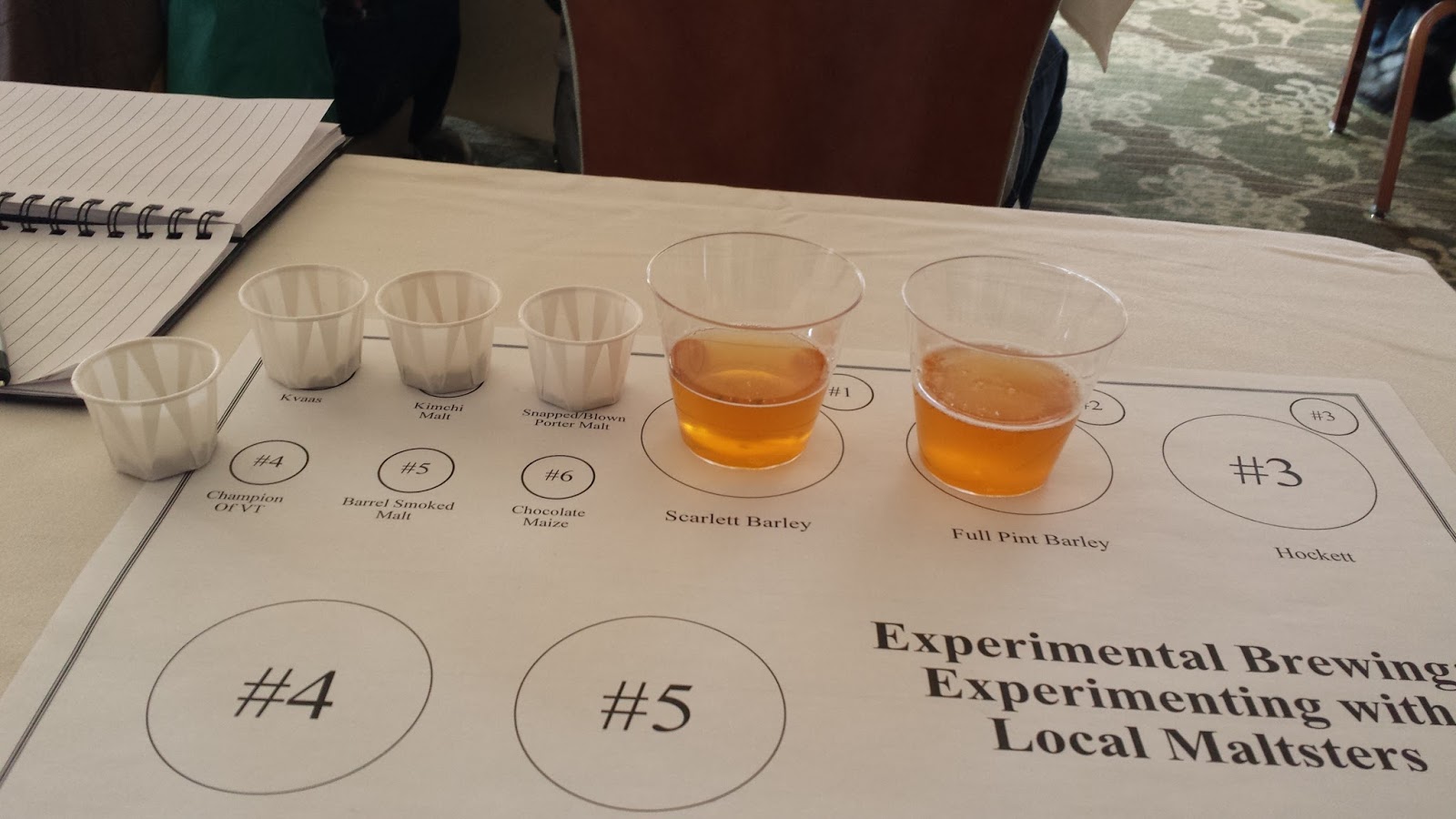
In a small facility in western Massachusetts, Andrea Stanley is doing everything she can to come up with varieties of small-batch malt that are going to differentiate the small-batch brewers who use them. Sometimes that involves dipping back into brewing history to revitalize brown porter malt. And sometimes that means going where no one thought beer makers would want to go — like soaking malt for two weeks in a crock pot with kimchi to invent a whole new flavor.
What Stanley, owner of Valley Malt, and a small number of other craft maltsters — there are 44 operating in the United States now, with 26 more malt houses under construction — are doing is taking back an industry sector that largely is in the hands of big corporations. Craft maltsters produced just 0.4 percent of the supply in North America in 2016. Then again, that's about the percentage of American beer that craft brewers were making in the early 1980s as well.
And while big malt houses will churn out exciting products every once in a while, they are not coming up with the Kvaas malt or bourbon-barrel-smoked malt that Stanley is. And most are not offering single-variety malts like Colorado Malting Company of Alamosa, experimenting with the flavors that a lone crop can give to a beer.
"This is the way that things are moving," said Chad Yakobson, the founder of Crooked Stave Artisan Beer Project who recently worked with Casey Brewing and Blending to make two versions of their Von Pilsner with two different malts and produced strikingly different flavors. "Malt is beer ... So, without it, what do we have?"
Stanley, Yakobson and others gathered at the recent Big Beers, Belgians and Barleywines Festival in Breckenridge for a panel discussion on experiments with local malt. The talk was eye-opening in regard to the possibilities of flavors not yet achieved by American brewers through the use of new varieties of one of the four main ingredients (with water, hops and yeast) that go into a beer.

Jason Cody, president and CEO of Colorado Malting Co., explained that he worked with the ever-experimental Three Barrel Brewing to make three varieties of the same ale, each with their own strain of single-variety malt — unusual in an industry that relies heavily on blended malt. And the samples of the beers they poured at the seminar were wholly unique - one light and jasmine-tinted, one traditionally earthy and a third almost flowery.
"This was a huge eye-opener for me," said Will Kreutzer, brewer and manager of the Del Norte beer maker, who works closely with father-in-law owner John Bricker (both pictured with Cody, above).
Yakobson's two Von Pilsners — one with Weyermann Pilsner malts and the other with Leopold Brothers floor-malted barley — also felt like different beers. Weyermann malts made the beer feel exceptionally clean and seemed to accent an airy quality, while the Leopold Brothers malt gave its offering qualities that were sweeter and somewhat chewy.
Stanley didn't bring beer samples but presented the malts almost as a breakfast supplement. (This, after all, was the 9:30 a.m. seminar on Saturday of the festival.) And while the kimchi malt was the most vibrant and palate-startling of the bunch — even if it would be difficult to pinpoint exactly what style of beer would benefit from its characteristics — varieties like the Kvaas malt, made from rye, gave hints of the bready, almost historical flavors that could be brought out with such new efforts.
"Are we going to transition all of our beer to be flavored with kimchi malt? The answer is obviously 'no,'" said John Mallett, the director of operations for Bell's Brewery who was presenting with Stanley. "But I love that malts like that are being made."

Craft brewers have used hops, yeast and additive ingredients to create new flavors and whole new styles of beer over the past 25 years. So, it's wonderful to see that by tweaking what is arguably the most staid of beer's primary ingredients, they may be about to push the flavor profile of this traditional beverage that much further.
Labels: Bell's Brewing, Big Beers, Casey Brewing, Colorado Malting Company, Craft malting, Crooked Stave, Leopold Brothers, Three Barrel Brewing
Sunday, May 29, 2016

Tucked back into the corner of Saturday's Funk and Farm Fest at Nighthawk Brewery, Trinity Brewing and Mu Brewery had an intriguing duo of beers on tap. Trinity was pouring a Saison Delivery - made with apples and grains of paradise and aged in chardonnay barrels - that was blowing everyone away by being tart and fruit-forward without being either blistering or cloying. And Mu was serving up a Key Lime Saison with Brett aged in Merlot barrels that, if slightly less polished, was a bold experiment at amping up both the sweetness and the pucker factor.
While different, the two beers offered great examples of just how many exciting directions the world of saison brewing is going. Surrounding them were farmhouse ales that tasted vaguely of cotton candy that cut through your taste buds with a sour golden bite and that clashed a sharp tartness with the big taste of the whiskey barrel in which they were aged - each one worthy of kudos.
 To think, when New Belgium tried to introduce a saison 20 years ago - a story I recounted in my book, "Mountain Brew" - beer drinkers didn't take to it because they largely weren't ready for the traditional Belgian style to blend with the rising flavors of hops and roasted barley in America. Now no major brewery is without one in its portfolio, and the best are rolling out more and more variations - Great Divide's full, fruity and slightly flowery Nadia Kali hibiscus saison being the latest really tasty one to hit the market - just to keep up with demand.
To what should we attribute the saison boom? A big factor is the demand among beer geeks for more that is different and cutting edge. Saison as a style allows for greater experimentation that most, presenting a slightly estery, slightly spicy base that lends itself to a ton of different adjuncts. But it also is a medium-bodied beer that can appeal to a wide range of drinkers, depending on what is thrown into the brew kettle.
I think back to my birthday party in 2015, when I asked friends to bring a saison and we did a blind taste testing to determine our favorite. That a Casey Brewing and Blending Saison won the general poll was not a surprise, as the Glenwood Springs beer auteur has managed to craft a version of the style that is bright and slightly tart and excites the taste buds continually. But the variety of saisons that scored high in our tallies - from Epic's Sour Apple Saison to Three Barrel's peppery Pemba Sherpa Saison - made it clear that there was a lot to like on the market.

Similarly, Nighthawk's farmhouse festival left few stones un-turned. Wynkoop's Forethought Barrel-Aged Sour Saison was a jolting and fascinating combination of strong flavors. Atom Brewing's Arlo farmhouse-inspired ale presented a huge sweetness developed surprisingly through open-air fermentation. Spangalang's Ethel, a sour saison, was bright and eye-opening without being punishing on the taste buds.
There is a lot to enjoy in the greater saison field today. But what is more exciting is the nearly blank slate from which brewers can develop more creative and more challenging saison varieties to come. The style may have originated with farm owners in Belgium and France. But what American brewers are doing with it is taking it to a whole new level.
Labels: Atom Brewing, Casey Brewing, Epic Brewing, Great Divide, Mu Brewery, Nighthawk Brewing, Saisons, Spangalang Brewery, Three Barrel Brewing, Trinity Brewing, Wynkoop Brewery
Friday, January 08, 2016

For the first time in 10 years, I won't be attending the Vail Big Beers, Belgians and Barleywines Festival this year. The impending birth of our daughter had to trump plans to indulge in beautiful, high-alcohol beer all weekend — though don't think I didn't have to pause at least a little bit before making the decision to stay home.
For those of you lucky bastards who will be headed up Interstate 70 for the festivities, however, a world of tasting and pairing opportunities awaits you over the next two days. And if I might be so bold as to offer a few suggestions, here are the tips from a veteran on how to get the most out of the experience.
1) Start Saturday at the experimental tasting seminar.

One of the best things about the festival is that it allows you to start your day Saturday by tasting beer at 9:30 a.m. without anyone casting aspersions on your character. These seminars — which have ranged from barrel-aged beers to saisons and which this year focuses on Koelschips — feature the best brewers from Colorado and the country expounding on daring ways to make their beer. And, yes, you get to be trying a sour ale at the same time that most people are pouring milk on their Fruit Loops. But it feels less like an early-morning tailgate and far more more like a fine-dining experience.
2) Ask what they made for the show.
Few Colorado beer festivals inspire brewers to create products specifically for that show. But breweries from Great Divide to Grimm Brothers have been known to bust out barrel-aging experiments just to try them out on the crowd. Hell, Crazy Mountain Brewery debuted at the 2010 festival just to get reaction to its first beers. If something doesn't look familiar at a booth, ask about it and try it; it just may be the best thing you find there.
3) One (pseudo)-secret brewery is a must-stop.
Brewers from Sam Calagione to Adam Avery will be the people actually pouring the beer for you, and that is a wonderful perk to Big Beers. You can ask them about their experiments and try the latest thing in their arsenals, and the national places you love should be on your hit list. (See my wife, Denise, above, loving her Rumpkin in 2015.) But the smaller brewers in attendance are there for a reason, and there are some diamonds among them.
It was about three or four years ago at this festival that Three Barrel Brewing of Del Norte stopped being the best-kept secret in Colorado brewing and just became one of the up-and-coming sour makers in the state. Owner John Bricker typically brings up between five and 10 experiments that may involve chili, chocolate or other ingredients not often found in the genre. And chances are that at least one of them will be among the most talked-about offerings of the event.

The bar at the Vail Cascade, home resort of the event, is one of the great craft-brewing outposts off of the Front Range. Featuring a beer program launched by festival co-founder Laura Lodge (pictured above), it's a place that has a cellar list, taps from mountain craft breweries and a good range of options. Plus, this is where the brewers themselves hang out when not serving up their creations, so it's a good chance to talk beer with the biggest experts in the industry.
5) Attend a dinner.
Beer dinners abound, both those arranged by the festival and more that are just popping up at locations around Vail. If there ever was a festival meant to pair beer and food, it's one that showcases the highest-ABV creations that are not 12-ounce bar beers so much as they are perfect to sample in smaller portions with, say, wagyu beef sushi. The dinners are incredibly chill events and, as this picture from 2015 demonstrates, even infants can sneak in if you're polite to the organizer. But this is a chance to experience and enjoy beer in a new way.

Labels: Avery Brewing, Beer dinners, Big Beers, Crazy Mountain Brewing Company, Dogfish Head, Great Divide, Grimm Brothers Brewhouse, Three Barrel Brewing, Vail Cascade
Tuesday, December 31, 2013

Thinking back on the best that Colorado had to offer in 2013, I am struck most by the scrappy and transient natures of the honorees.
Just two of my favorite 10 beers of the year was made by breweries — Ska and Epic — that distribute to more than one state outside of Colorado. That's not to say that the giants of Colorado craft brew that usually dominate this list — Great Divide, Odell, Avery, etc. — did not produce great beers; they just seemed to be outshined by some of the creativity emanating from the state's little guys.
Also, my greatest beef with the beers on this list was that many came and went so quickly, available for limited times and sometimes in extremely limited quantities, that the conversation around them was too limited for them to become part of the common beer vernacular. In those cases, I can only hope their brewers realize the gems they have created and crank them up in greater volume so that more people can experience their joy in 2014.
That said, without further ado ...
10. Cinnamon Almond Ale - Colorado Plus
At a time when brewers are becoming bolder about incorporating uncommon flavors, Adam Draeger took two flavors no one associated with great beer and made them sing in one of the most unique concoctions of the year. Allowing the almond to serve as the smooth landing for the spice of the cinnamon made this intriguing and unforgettable.
9. Watermelon Kolsch - Fate Brewing
This was the beer that proved that summer beers don't have to be boring - a light but crisp kolsch with a hearty dose of watermelon that provides huge refreshment at the same time it ups the complexity of this traditional German style.
8. Penitente Hermano - Three Barrel Brewing
One of the most exciting "exports" of the year was the arrival in Denver liquor stores of this creative brewery from the San Luis Valley. Penitente Hermano, a Belgian sour ale with a coriander kick on the back, paved its entrance after being one of the most gushed-over efforts of the 2013 Vail Big Beers, Belgians & Barleywines festival.
7. Sentience - Crooked Stave Artisan Beer Project
The way this Denver brewery is turning out fascinating sours, you could almost throw a dart blindly at a board of its offerings and put whatever it lands on onto this list. But the Sentience stood out as the "it" beer of the Avery Strong Ale Festival this year, a tart wild quad whose whiskey-barrel aging accented its sharpness perfectly.
6. Snowed In - Copper Kettle Brewing
We're so far into the Christmas beer trend that you don't think anything can surprise you anymore. Then you have a sip of this imperial oatmeal stout aged six months in bourbon barrels with coffee and chocolate and you're not only blown away by its easy-drinking big-alcohol complexity, you have to tell yourself to hang out more at this east Denver brewery.
5. 4.0 Grapefruit Pale Ale - Bull & Bush Brewery
The idea of hopping a pale ale or an IPA to resemble a grapefruit was a very popular one this summer. But this Denver brewery took it a step further, adding grapefruit juice to the mix and turning out a low-alcohol summer creation that was one of the unique tastes of the entire year. Can't wait for this to come back in 2014.
4. Two Tone Montanya - Ska Brewing
The most impressive Colorado sour of this year was this Belgian dubbel aged in Montanya rum barrels to take on a tart citrus character combined with a big, sweet body. This is arguably the finest beer made by the 18-year-old brewery.
3. Fan Boy - Elevation Beer
At some point, you really believe that no matter how good a new IPA can be, it won't be inherently different than what it out there already. Then you taste this oak-barrel-aged double IPA, filled with a full mouth of hops but also with oak and vanilla and introducing to this market something acutely original - and phenomenal in its flavor.
2. Devil's Riddle Ale - Grimm Brothers Brewhouse
The most unique beer I tried in 2013 was this strong ale aged nine months in Buffalo Trace barrels with Brettanomyces. It was musty, it was big, it was biting me with a strange tartness that came out of nowhere. It was complex. It was great. And it may just signify a new era for these German beer makers from Loveland.
1. Big Bad Baptist - Epic Brewing
Those outside of the Denver area were able to enjoy this monster of an imperial stout (10.5% ABV), made with cocoa nibs and with a tone of coffee. But when Epic opened its Colorado brewery in May, it was a revelation to the rest of us, a darker-than-night whirlwind that could knock you down with its alcohol but somehow was just smooth enough to allow you to drink more than you should. No beer generated more talk this year, whether in its classic form or when it was mixed with Strange Brewing's Cherry Kriek - a combination that shouldn't have worked but somehow did. Few beers were more satisfying. And that's the mark of a beer of the year.
Labels: Bull and Bush, Colorado Plus Brew Pub, Copper Kettle Brewing, Crooked Stave, Elevation Beer, Epic Brewing, Fate Brewing, Grimm Brothers Brewhouse, Ska Brewing, Three Barrel Brewing, Top Beers of Year
Saturday, November 09, 2013

With so many beer festivals in Colorado, a lot of them tend to blend together. And for the first six years of its existence, the All Colorado Beer Festival in Colorado Springs fell into that category of fun but unspectacular.
Something was different about this year's version, though - different enough where the ACBF might have to move into that don't-miss category in 2014. And it was a combination of things that elevated it.
First, the sheer number of breweries set the festival apart. Last year there were 37 beer makers pouring their products there. This year the number rose to 68 - all from Colorado, many small, some just barely open. Kudos to organizer Randy Dipner for that.
Second, one of the drawbacks of this fest in the past, like many massive beer gatherings, was that many of the breweries crammed into the space were offering the same beers you could find on any shelf all year long. That wasn't true this year.
From Gravity Brewing's intriguing Belgian Peppercorn Ale to Epic Brewing's fabulous coffee bomb Big Bad Baptist to Verboten Brewing's Good Day to You - a chocolate porter with sea salt - the Freedom Financial Services Expo Center floor was lined with new and different offerings. Even when a brewery brought something that missed wildly - such as Fort Collins Brewery's overwhelming Mesquite Chili Lime Ale - it missed by trying, not resting on its laurels.
Third, the VIP area continues to shine and is well worth the extra money. It was there that Grimm Brothers poured the tastiest beer of the festival, if not of the entire year, in its Devil's Riddle Ale, a strong ale aged nine months in Buffalo Trace barrels packed with Brettanomyces to complex effect. And it was there where the likes of New Belgium, Three Barrel and Trinity could happily turn an ordinary festival into a sour festival.
Finally, as a "celebrity judge" for the second year, I had the privilege of helping choose the winners in the IPA/imperial IPA category, and I noticed a huge difference in the quality of entrants just from last year. So when we blindly picked New Belgium's Rampant Imperial IPA for the gold medal and Dry Dock's Hop Abomination IPA for the silver (as shown in the photo at the top), it felt like we were honoring about the best in the state, not just the best there.
The ACBF typically occurs about a month after the Great American Beer Festival. If you haven't been yet, it's worth making a trip to Colorado Springs next year to do so.
Labels: All Colorado Beer Festival, Dry Dock Brewing, Epic Brewing, Fort Collins Brewing, Gravity Brewing, Grimm Brothers Brewhouse, Three Barrel Brewing, Trinity Brewing, Verboten Brewing
Monday, July 15, 2013

Sure, there were 73 breweries planted in Salida's Riverside Park - the largest gathering of beer makers at an outdoor festival in Colorado history. But it wasn't the number of brewers so much as the age; at least half of them, by my count, were less than three years old.
And it was that youth, that seeming camaraderie of spirit to define Colorado beer in their own terms, that just imbued this past Saturday's Colorado Brewers Rendezvous with a certain energy, a certain newness. And one couldn't help but walk away with a few trinkets of knowledge from the Colorado Brewers Guild's annual signature event about where the state of the craft brewing industry is going.
1) Tart sours were sooo 2012. Now, even the boundary-pushing beers are having their boundaries pushed in new directions.
Take, for example, Trinity Brewing's Damn It Feels Good to Be a Gangsta, an intriguingly dark and chewy sour that combines the tastes of roasted chocolate, raisin and a tart cherry strain. It's enough to make you stop and think a little longer than usual.
 Or, if roasty sour wasn't quite enough, Three Barrel Brewing took it a step further and added ancho chile to the already jarring taste of a chocolate sour and might have made the intriguing beer of the festival with its Melaza. The Del Norte brewery is supposed to have beer in at least one Denver liquor store by the end of the summer, and it couldn't come soon enough.
2) The more herbs or spices in the beer, the more fascinating it gets.
Example A is Cannonball Creek's Rosemary Sourdough Saison, whose lighter body allows you to taste not only the floral flavor of the rosemary but just a hint of sour. Combined with Strange Brewing's excellent Zora Rosemary Pale Ale, and you have two area beers that make a baker jealous of their flavors.
Example B is Copper Kettle's Mexican Chocolate Stout, a time-tested pleaser with a chocolate-cinnamon come-on and back-of-the-tastebud kick that is now available in bottles. Everyone should try this at least once.
3) Dare I say there is a kolsch battle going on in Colorado? Steamworks was serving up its Colorado Kolsch, which is by no means new but continues to set the standard for crisp and refreshing in this state with just enough light hops to give it full flavor.
But I have to hand it to Elevation Beer, whose 8 Second Kolsch was on tap at every bar in Salida. It is sweeter, with just a hint of light fruit to its heavier-than-hops malt taste. And it presents the state with a good problem: Which of two kolsch beers to spend time with this summer.
 4) You know who's impressive? Fate Brewing. Yes, one could have picked out almost any brewer at the rendezvous, admittedly, for recognition. But the new Boulder brewer, which kicked convention in the teeth by making a fantastic watermelon kolsch already this summer, debuted its Gose Saturday.
It takes guts to make a German sour to begin with, but this version calms the salty overtones too often prevalent in the style and adds a citrus twang without a peltingly sour body. At the very least, it will be fascinating to watch where this 5-month-old brewery goes.
Labels: Cannonball Creek Brewing, Colorado Brewers Guild, Colorado Brewers Rendezvous, Copper Kettle Brewing, Elevation Beer, Fate Brewing, Steamworks Brewing, Strange Brewing, Three Barrel Brewing, Trinity Brewing
Sunday, January 13, 2013

Brenda - a member of the Fearless Tasting Crew - opined this morning that she is worried sometimes about the rising costs of beer festivals. But one day after the Crew had just had another very successful outing at the Vail Big Beers, Belgians and Barleywines Festival, she added that this particular event was worth every penny. And she's right.
A "big beer" once was anything that was 7 percent alcohol by volume or greater, and breweries routinely offered high-volume IPAs and similar-tasting imperial stouts to satisfy that definition. Now, flavors of all kind - the most common this year was peach - are added to already gutsy beers, bacteria work their magic in even the smallest breweries and Belgian-style sours seem to be as common as bold dark beers.
A rote list of all the good things that could be found at the festival would take up more time than anyone reading this has to give. But here are a few of the highlights that extreme beer drinkers hopefully will be able to experience even if they didn't make the festival.
1. If there was one beer that generated the most buzz, it was Firestone Walker's Sour Opal, one of the first products of the California brewery's new Barrelworks program. The brewery is bringing in wine barrels and then inoculating the beer in them with brettanomyces, lactobacillus and pediococcus. In the case of Sour Opal, the result of three years of aging was that a charming little saison became a very sweet and tart offering that absorbed enough from the barrel to be far darker than similarly aged lighter beers. And in a show full of great sours, this one stood out.
2. Tiny Three Barrel Brewing of even tinier Del Norte, Colo. has earned its way to being mentioned with some of the biggest craft breweries in America. Its Penitente Hermano, a Belgian sour ale that comes on with a lemon nose and ends with a slightly spicy backbone of coriander, was one of the most original beers on the floor. Owner John Bricker said - and, yes, conversation with the brewers is one of the greatest things about Big Beers - that he wants to start growing distribution outside the San Luis Valley this year. The Denver beer scene will be better for it.
3. It's become an annual ritual that new breweries looking to make a name for themselves among beer geeks roll out products at Big Beers even before they've opened. And the eye-opening new kid on the block this year was Roadhouse Brewing, which is set to start serving beers in about two weeks in Jackson, Wyo. The Belgian-heavy brewery offered up a Siren Song Belgian Strong Ale that hit with an upfront bubble gum flavor and finished with refreshing bitterness, courtesy of a larger-than-usual amount of hops. And its Sacred Creed Saison was a dangerously easy, candied and light-bodied 7.3 percent monster. Add the fact that Jackson also is home to Snake River Brewing and Thai Me Up - winner of Great American Beer Festival gold medals last year for both strong pale ale and imperial IPA - and the resort town suddenly is a must-stop on the Rocky Mountain beer trail.
4. Biggest surprise of the festival? It was either the fact that The Bruery didn't show up or that Backcountry Brewery showed up in such a big way. The Frisco brewery has always been a great ski-town stop with very good takes on more common styles, such as the IPA or its breakfast stout. But no one expected its Tart SaiZyn, a pungent-but-not-quite-sour saison aged in zinfandel barrels until it hit the perfect level of drinkability. Brewer Alan Simons says Backcountry is expanding distribution to get its most popular beers in liquor stores up and down the Front Range this year. Let's hope he throws in a couple of the new experimental batches as well.
5. Experimentation is the name of the game at Vail Big Beers, and unusual flavors - whether it was Great Divide's Peach Grand Cru or Denver Beer's 14 percent Killer Icicle Eisbock - were generally appreciated. But Tenth and Blake, the "craft beer" division of MillerCoors, jumped way past clever to just plain absurd with its Bubblelicious Weisse, a thin-tasting German sour beer that included the same translucent gummy balls full of fruit flavoring that are found commonly at self-serve yogurt bars. It's a truism that if you have to put something on the outside of your beer glass - say, a lime - you're masking a poorly made beer. But if you actually have to put something inside a glass of beer to try to make it more appealing, you ought to just find a way to make better beer.
Labels: Backcountry Brewery, Big Beers, Denver Beer Co, Firestone Walker Brewing, Great Divide, Roadhouse Brewing, Tenth and Blake, Three Barrel Brewing

