Tuesday, October 24, 2017
It's the Same Great Pumpkins, Charlie Brown

This set out to be a column about the newest and boldest pumpkin beers on the market, the ones that 12 friends haven't already recommended to you for several years in a row.
The problem is, however, that those particular beers that pair well with black cats and slasher movies have earned their reputations for a reason - they're the ones that are made well, year after year, even as the quality of other beers of this style can vary pretty widely. And at a time when fewer new breweries seem to be attempting to make potables out of hoards of gourds, the chasm between great pumpkin beers and others seems to be widening, leaving the classics on an island of their own.
Is that a sign that the style is losing popularity? Not necessarily, as pumpkin beers always have been polarizing and some brewers have never liked trying to assemble them at all. Not just that, but while some breweries are avoiding the genre, others (see Southern Tier Brewing) are making multiple versions using the same seasonal ingredient, almost single-handedly pumping up the style.
 Or does it mean that we've run out of original ideas for how to mix together pumpkins, spices and malts to create something new and interesting? It doesn't have to, although some of the most creative beers at the recent Great American Beer Festival were meant to be year-round pleasers, not those narrowed to an annual release.
But the best of the style simply remain the best of the style. And it is to those beers that tribute should be paid.
Southern Tier's Pumking Imperial Ale remains the most creative and compelling pumpkin creation out there, a virtual pumpkin pie in a glass. You're struck immediately by the scent of pie crust with just a hint of mixed spices, and the creamy nature of the beer gives a distinct impression of pie filling. Plus, the alcohol is extremely subdued for an 8.6% ABV beer.

Nearly as compelling - but, sadly, not available in Colorado - is Schlafly Pumpkin Ale out of St. Louis. There is a full malty body with both sweet and subtly spice-laced undertones here, and it's a complex adventure for one beer. Pressure needs to be exerted to get it here more than just during GABF.
In Colorado, you can't do better than 4 Noses Brewing's Pump Action, an also not-so-alcohol-apparent imperial pumpkin ale that comes on with a full mouth of spice but less of residual hot back taste than many others of the ilk. It uses its amber body particularly well as a cushion to smooth out the tastes of nutmeg and cinnamon, leaving them pleasing without being acerbic.
Neck and neck with it in Colorado is Upslope Pumpkin Ale, which, like Pump Action, has taken home GABF medals. This cranks up the six spices in the beer a little bit and tones down the sweetness of the pumpkin but settles with a bready, heavy body that zings you without overpowering.
 One of the most improved pumpkin beers in the state is Denver Beer Co's Hey! Pumpkin, a smooth and almost creamy offering that goes lighter on the spices and heavier on the pie-like baking sugar. There's barely any bitterness on the back end, leaving it more approachable while still full of flavor.
And maybe the one surprise of the season was Uinta Brewing's Funk'n Patch Brett Pumpkin Ale, a beer that adds enough to perk up the lively, funky characteristics of the beer while pushing it just slightly into the category of sour. The Utah brewery's beers tend to vary wildly in terms of hitting the mark, but this one delivers in a differentiated, put-the-fun-back-in-pumpkin-ales way.
There's a chance that none of that is news to you. But it's worth reiterating all the same that there are breweries, even if a select number of them, that are doing pumpkin beers well and giving you incentive to reach out and try some before the calendar turns to November.

This set out to be a column about the newest and boldest pumpkin beers on the market, the ones that 12 friends haven't already recommended to you for several years in a row.
The problem is, however, that those particular beers that pair well with black cats and slasher movies have earned their reputations for a reason - they're the ones that are made well, year after year, even as the quality of other beers of this style can vary pretty widely. And at a time when fewer new breweries seem to be attempting to make potables out of hoards of gourds, the chasm between great pumpkin beers and others seems to be widening, leaving the classics on an island of their own.
Is that a sign that the style is losing popularity? Not necessarily, as pumpkin beers always have been polarizing and some brewers have never liked trying to assemble them at all. Not just that, but while some breweries are avoiding the genre, others (see Southern Tier Brewing) are making multiple versions using the same seasonal ingredient, almost single-handedly pumping up the style.
 Or does it mean that we've run out of original ideas for how to mix together pumpkins, spices and malts to create something new and interesting? It doesn't have to, although some of the most creative beers at the recent Great American Beer Festival were meant to be year-round pleasers, not those narrowed to an annual release.
But the best of the style simply remain the best of the style. And it is to those beers that tribute should be paid.
Southern Tier's Pumking Imperial Ale remains the most creative and compelling pumpkin creation out there, a virtual pumpkin pie in a glass. You're struck immediately by the scent of pie crust with just a hint of mixed spices, and the creamy nature of the beer gives a distinct impression of pie filling. Plus, the alcohol is extremely subdued for an 8.6% ABV beer.

Nearly as compelling - but, sadly, not available in Colorado - is Schlafly Pumpkin Ale out of St. Louis. There is a full malty body with both sweet and subtly spice-laced undertones here, and it's a complex adventure for one beer. Pressure needs to be exerted to get it here more than just during GABF.
In Colorado, you can't do better than 4 Noses Brewing's Pump Action, an also not-so-alcohol-apparent imperial pumpkin ale that comes on with a full mouth of spice but less of residual hot back taste than many others of the ilk. It uses its amber body particularly well as a cushion to smooth out the tastes of nutmeg and cinnamon, leaving them pleasing without being acerbic.
Neck and neck with it in Colorado is Upslope Pumpkin Ale, which, like Pump Action, has taken home GABF medals. This cranks up the six spices in the beer a little bit and tones down the sweetness of the pumpkin but settles with a bready, heavy body that zings you without overpowering.

And maybe the one surprise of the season was Uinta Brewing's Funk'n Patch Brett Pumpkin Ale, a beer that adds enough to perk up the lively, funky characteristics of the beer while pushing it just slightly into the category of sour. The Utah brewery's beers tend to vary wildly in terms of hitting the mark, but this one delivers in a differentiated, put-the-fun-back-in-pumpkin-ales way.
There's a chance that none of that is news to you. But it's worth reiterating all the same that there are breweries, even if a select number of them, that are doing pumpkin beers well and giving you incentive to reach out and try some before the calendar turns to November.
Labels: 4 Noses Brewing, Denver Beer Co, Fall seasonals, Great American Beer Festival, Pumpkin beers, Schlafly Beer, Southern Tier Brewing, Uinta Brewing, Upslope Brewing


Saturday, April 01, 2017
Salt Lake's Beer Scene: Growing and Evolving

Walking into a bar or brewery in Salt Lake can be confusing - especially the first time you order a draft IPA, feel it's lacking body and then realize that nothing coming out of the taps tops 4 percent alcohol by volume, even if the bottled beer you order at the same location can be of any strength. But you'll get that pattern down a few beers in.
Once you've mastered the nuances of local alcohol law, there's a lot to like in Utah's capital city. Visiting there two weeks ago to watch my alma mater play in the NCAA tournament, I was pleased by the compact nature of its downtown, the proximity of several different breweries to major attractions and the long local beer lists I encountered even at sports bars. The scene as a whole is worth lauding.
Offerings from brewery to brewery and even among one brewery's portfolio were inconsistent (which, in truth, is not that much different than the Denver scene). But after a couple of days in which drinking was no less than a co-main activity, several things jumped out.

The stand-out brewery in Salt Lake is Red Rock Brewery, which was the 2007 Large Brewpub of the Year at the Great American Beer Festival. Its Lady Ga Gose, resplendent in its bright and lemony tartness with just the right amount of salt on the back taste, was a full-flavored treat even with its low ABV. And its Elphino Double IPA was one of the more complete hop bombs in the city, offering a big mouthful of grass and flowers, layered with a hint of a bitter bite and a fair cushion of malts.
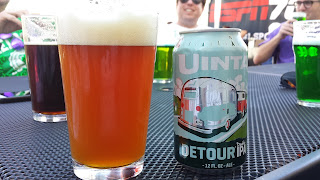
Uinta Brewing's Detour Double IPA set an even higher standard for hop vehicles, seemingly assaulting your taste buds with a sticky, aggressive flavor that was slightly less than balanced but left a powerful aftertaste. But other offerings from the brewer varied wildly, from its much-hoppier-than-expected, refreshing 801 Pilsner to its terribly bland Ready Set Gose, which tasted more like a slightly kicky pilsner than a member of the sour family.
 Wasatch Brewing, whose products are omnipresent on Salt Lake tap lists, also had more than one notable offering. Its Devastator Double Bock was one of the great surprises of the trip, pouring bold and smooth with an almost woody flavor but no residue of heavy alcohol in its 8 percent ABV body. And its Snap Down Header India Pale Lager was one of the perkier low-alcohol offerings in town, presenting a zing of hops in a light but enjoyable body.
Squatters Brewery also had a low-alcohol pleaser with its Apricot Hefeweizen, which was bright and decently fruited and, frankly, a perfect option for the 11 a.m pre-tailgate tasting. But its Hop Rising Double IPA was straight-out-of-the-early-2000s bitter without a lot of complexity. And its darker offerings, particularly Captain Bastard's Oatmeal Stout, were extremely light-bodied and forgettable.
 Moab Brewery offered a couple of non-stand-out beers that seemed a bit light for their style, such as the Red Rye IPA that was an incongruous mix of a red and an IPA. And Proper Brewing tried to push the envelope on low-alcohol beers with offerings like its Salted Caramel Porter, but they felt slight when coming off the taps, seemingly lacking the full body they needed.
Finally, I will admit that I didn't seek out Epic Brewing offerings, since they are as available in Denver as they are across Colorado's western border. But the two-state brewery's Session IPA may have been the most sharply hopped lower-alcohol beer in the city, a reminder that big flavor does not have to come from big booze.
Salt Lake isn't Denver, and it doesn't appear to have the same reserve of caution-be-damned brewers like Crooked Stave or Spangalang Brewery that seek to destroy taboos involving flavor experimentation. But its growing scene is filled with subtle gems, all of which bodes well for it to continue to expand and diversify in years to come.

Walking into a bar or brewery in Salt Lake can be confusing - especially the first time you order a draft IPA, feel it's lacking body and then realize that nothing coming out of the taps tops 4 percent alcohol by volume, even if the bottled beer you order at the same location can be of any strength. But you'll get that pattern down a few beers in.
Once you've mastered the nuances of local alcohol law, there's a lot to like in Utah's capital city. Visiting there two weeks ago to watch my alma mater play in the NCAA tournament, I was pleased by the compact nature of its downtown, the proximity of several different breweries to major attractions and the long local beer lists I encountered even at sports bars. The scene as a whole is worth lauding.
Offerings from brewery to brewery and even among one brewery's portfolio were inconsistent (which, in truth, is not that much different than the Denver scene). But after a couple of days in which drinking was no less than a co-main activity, several things jumped out.

The stand-out brewery in Salt Lake is Red Rock Brewery, which was the 2007 Large Brewpub of the Year at the Great American Beer Festival. Its Lady Ga Gose, resplendent in its bright and lemony tartness with just the right amount of salt on the back taste, was a full-flavored treat even with its low ABV. And its Elphino Double IPA was one of the more complete hop bombs in the city, offering a big mouthful of grass and flowers, layered with a hint of a bitter bite and a fair cushion of malts.

Uinta Brewing's Detour Double IPA set an even higher standard for hop vehicles, seemingly assaulting your taste buds with a sticky, aggressive flavor that was slightly less than balanced but left a powerful aftertaste. But other offerings from the brewer varied wildly, from its much-hoppier-than-expected, refreshing 801 Pilsner to its terribly bland Ready Set Gose, which tasted more like a slightly kicky pilsner than a member of the sour family.
 Wasatch Brewing, whose products are omnipresent on Salt Lake tap lists, also had more than one notable offering. Its Devastator Double Bock was one of the great surprises of the trip, pouring bold and smooth with an almost woody flavor but no residue of heavy alcohol in its 8 percent ABV body. And its Snap Down Header India Pale Lager was one of the perkier low-alcohol offerings in town, presenting a zing of hops in a light but enjoyable body.
Squatters Brewery also had a low-alcohol pleaser with its Apricot Hefeweizen, which was bright and decently fruited and, frankly, a perfect option for the 11 a.m pre-tailgate tasting. But its Hop Rising Double IPA was straight-out-of-the-early-2000s bitter without a lot of complexity. And its darker offerings, particularly Captain Bastard's Oatmeal Stout, were extremely light-bodied and forgettable.

Finally, I will admit that I didn't seek out Epic Brewing offerings, since they are as available in Denver as they are across Colorado's western border. But the two-state brewery's Session IPA may have been the most sharply hopped lower-alcohol beer in the city, a reminder that big flavor does not have to come from big booze.
Salt Lake isn't Denver, and it doesn't appear to have the same reserve of caution-be-damned brewers like Crooked Stave or Spangalang Brewery that seek to destroy taboos involving flavor experimentation. But its growing scene is filled with subtle gems, all of which bodes well for it to continue to expand and diversify in years to come.
Labels: Epic Brewing, Moab Brewery, Proper Brewing, Red Rock Brewery, Salt Lake City, Squatters Brewery, Uinta Brewing, Utah, Wahsatch Brewery
Sunday, January 11, 2009
 Bigger But - More Importantly - Bolder
When 83 breweries show up to a festival bringing the biggest beers they make, you expect a lot of bourbon barrel-aged stouts, double IPAs and Belgian-style tripels. And, yes, there were plenty of each of those at Saturday's ninth annual Big Beers, Belgians and Barleywines festival.
But what really stuck out this year was not just how outrageously hoppy or malty the beverages gathered in the Vail Marriott Mountain Resort were, but how creative brewers have become in making beers of at least 7 percent alcohol by volume. And thus, the event served as a peek at what the future of beer might be.
"I think 20 years from now, we'll look back and recognize now as the point where the gloves came off and consumers really recognized what beer had to offer," said Dogfish Head maestro Sam Calagione, whose recent New Yorker profile only helped to raise the visibility of big beers.
Standing out among all the giant American experimenters and ageless Belgian masters, for example, was Altitude Chophouse and Brewery of Laramie, Wyo., a brewpub so small that it considered bottling but had to nix the idea because of cost concerns. Yet, it grabbed a lot of the talk at the festival with a Cayenne Cocoa Bock that creatively combined inky, chocolaty darkness with a late-breaking fleck of heat that served as a defibrillator for the tongue.
If it wasn't a peppery bock grabbing attention, then it was one of several Belgian pale ales that brewers were rolling out. Stone Brewing led the way with a Cali-Belgique IPA, first released in August, that artfully blended hoppy floralness with Belgian esters to create something shockingly smooth. But Utah-based Uinta Brewing and Belgium's La Chouffe were among the others who also put their own versions on display, with the Belgian-made entry having significantly less of a hop characteristic.
Big, gutsy saisons also are making their imprint on a style that hasn't been as bold in the past. Several were on display in Vail, including a very sweet and drinkable Saison Rue from California-based The Bruery, a beer that could become the boldest beer of the spring and summer seasons.
And, of course, the continuing fascination with Belgian-style sour ales remains in place. Between Russian River's latest batch of Consecration (which they cracked open at the Great American Beer Festival this year), Cambridge Brewing's Cerise Casee (my personal favorite beer of the GABF) and Deschutes Brewery's Dissident Old Bruin, the best trend in American beer continues to get better.
That said, it's not like the traditional big beers are going away. There were no less than 21 barleywines, 15 tripels, 11 double or imperial IPAs and six bourbon-barrel-aged beers on display. Tasting a hopped masterpiece like Flying Dog's Double Dog Double Pale Ale reassures you the extreme beers that have been the focus of the past 10 years are still evolving art forms.
But now there are tastes for everyone, and more is still to come. At talks over the course of the day, apple and pear beers, huge coffee porters and new experiments with Brettanomyces were all mentioned and may not be far away.
Yes, there truly is a big beer for everyone at this point. Now the trick is finding the time to drink them all.
Labels: Altitude Chophouse and Brewery, Big Beers, Cambridge Brewing, Deschutes Brewing, Flying Dog, Russian River, Stone Brewing, The Bruery, Uinta Brewing

