Monday, April 27, 2020
A Short Piece about the new Michigan Brewery in Town

Those who have swung by the Short's Brewing Co. booth at Great American Beer Festival likely walked away thinking that the northern Michigan brewery was all about fun and experimental games. Offering flavors from carrot cake to strawberry to peaches and cream, it grew a reputation starting about a half-decade ago for turning your head as you walked by and daring you not to stop and try.
About three months ago, the 16-year-old brewery began distribution in Colorado. Yes, the event seemed overshadowed when the whole world blew up about a month after it arrived here (which, by the way, was pure coincidence). But what seemed almost as strange was the brewery entering the state with a portfolio of offerings that could be considered - gasp - somewhat normal.
Its flagship beers that it began selling at liquor stores throughout the area included an IPA, a heavily fruited ale and a light beer, of all things. It also brought along three ciders from the Starcut Ciders facility it operates, as well as a hard seltzer, Beaches, that seems a mandate for all growing craft breweries (but that, like all seltzers, merits no further words).
Since coronavirus shifted so much of our liquor-store buying to curbside pickup and delivery, old favorites are in and newcomers like Short's feel like a luxury that many drinkers may not have time or resources to discover. But there are a couple of Short's offerings that the Colorado craft-enjoying world shouldn't overlook, even as it's putting so much energy rightly into buying locally.

Huma Lupa Licious IPA is an old-school, West-Coast-reminiscent beer that is very balanced, with a medium pine nose but also a little breadiness around the edges when it comes to its aroma. Though 7.7% ABV, it sits like a beer you could drink several of without it weighing you down.
Soft Parade - brewed with puree of strawberries, blueberries, raspberries and blackberries - looks like fruit juice and smells like berries but does not lack for real beer flavor. Plus, its 7.5% ABV base gives it just enough of a boozy, serious body to make you think about all the flavors you're imbibing.

Maybe the best offering of its entry class, however, was Pulsar, its dry cider made with Michigan apples and Pinot Noir yeast that has a tart enough tinge that it resembles an introductory sour ale. It's truly one of the more complex and advanced ciders you will try, and when considered alongside its Octorock hard cider, it demonstrates that Starcut, like the experimental Short's that beer geeks know, can draw a lot of flavor into its offerings.
That said, the Local's Light is an abundantly strange choice to bring into a mature beer market; there is little other than its smoothness that separates it from the megabreweries' light offerings, and it holds no appeal for those seeking new flavors. And Mosa, a blend of hard cider and orange juice, feels too much like the bad mixed drink you put together in college using orange juice stolen from the cafeteria, pounding you with sweetness and funk (though not the good Brett kind of funk) and just screaming "experiment gone wrong."

It frankly feels like an odd time to recommend any beer that was brewed more than 10 miles from your home. But when the world calms, Short's is a seasoned beer maker worth a try. And, just maybe, this guru of eclectic flavors can bring out to Colorado some more experiments the state will embrace.
Labels: American light lager, cider, Fruit beers, Great American Beer Festival, IPA, Michigan beers, Short's Brewing


Monday, April 09, 2018
Renegade's Pleasing Polite Side

Renegade Brewing's best beers traditionally have been the ones that go way, way off-style or outside the mainstream. Think beet saison. Think triple IPA. Think imperial peanut butter cup stout.
That's why it's both pleasing and surprising to see that its newest offering — its Free to Roam American Pale Ale, released officially on Saturday — is a gem specifically because it's subtle and yet imbued with big flavor. And while breweries can fluctuate from beer to beer in terms of what they nail and what they miss, Free to Roam feels like a very mature effort for a brewery that's about to undertake a significant expansion.
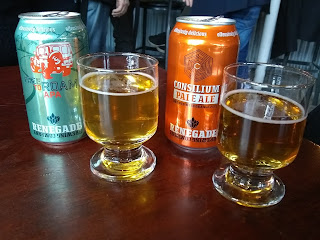
The beer replaces Consilium Pale Ale in the year-round lineup for the Denver brewery after a four-year run for that beer — and that's a good thing. Consilium was an early example of the fruited hop beer, and while that pale ale brewed with orange peel wasn't offensive like some other entries in the style, it had an almost chewy body and minimal hop flavor that never seemed to land it in a category that would please hop heads or more experimental drinkers.
Free to Roam tosses aside the actual fruit and replaces it with a mouthful of Citra hops, giving it the feel of a lighter-bodied IPA swimming in melons. But it doesn't go overboard on either the fruity characteristics or the bitterness, ending with just enough of a hop bite to prick your taste buds and then be gone. It's both ultra-drinkable and full of hop-reaching personality — a great beer especially for the coming summer season.
 The presence of Free to Roam doesn't mean Renegade is giving up on its fruited hop beers, for those who like that trend. Summer Tan, its deceptively boozy double IPA made with tangerine essence, is coming back this year and getting a run in cans into all five states in which Renegade distributes. It's an easy beer that isn't quite sure whether it wants to be bitter or fruity, but it at least is punchy with both flavors.
Free to Roam, however, is the kind of beer you'll be drinking all summer. And after Renegade recently snagged the Colorado Brewery of the Year award at the New York International Beer Competition, it's a further sign that the beer maker is upping its game.

Renegade Brewing's best beers traditionally have been the ones that go way, way off-style or outside the mainstream. Think beet saison. Think triple IPA. Think imperial peanut butter cup stout.
That's why it's both pleasing and surprising to see that its newest offering — its Free to Roam American Pale Ale, released officially on Saturday — is a gem specifically because it's subtle and yet imbued with big flavor. And while breweries can fluctuate from beer to beer in terms of what they nail and what they miss, Free to Roam feels like a very mature effort for a brewery that's about to undertake a significant expansion.

The beer replaces Consilium Pale Ale in the year-round lineup for the Denver brewery after a four-year run for that beer — and that's a good thing. Consilium was an early example of the fruited hop beer, and while that pale ale brewed with orange peel wasn't offensive like some other entries in the style, it had an almost chewy body and minimal hop flavor that never seemed to land it in a category that would please hop heads or more experimental drinkers.
Free to Roam tosses aside the actual fruit and replaces it with a mouthful of Citra hops, giving it the feel of a lighter-bodied IPA swimming in melons. But it doesn't go overboard on either the fruity characteristics or the bitterness, ending with just enough of a hop bite to prick your taste buds and then be gone. It's both ultra-drinkable and full of hop-reaching personality — a great beer especially for the coming summer season.
 The presence of Free to Roam doesn't mean Renegade is giving up on its fruited hop beers, for those who like that trend. Summer Tan, its deceptively boozy double IPA made with tangerine essence, is coming back this year and getting a run in cans into all five states in which Renegade distributes. It's an easy beer that isn't quite sure whether it wants to be bitter or fruity, but it at least is punchy with both flavors.
Free to Roam, however, is the kind of beer you'll be drinking all summer. And after Renegade recently snagged the Colorado Brewery of the Year award at the New York International Beer Competition, it's a further sign that the beer maker is upping its game.
Labels: American pale ale, Fruit beers, new beers, Renegade Brewing
Monday, September 18, 2017
The Fruited IPA: Can We Just Kill This Trend?
 Debate continues to rage after some two years on whether the New England IPA, a hazier take on the style with more citrus and tropical fruit overtones and less bitter bite, is inspired flavor or just laziness. But whether you like this slight variation on America's favorite craft-beer style or not, this discussion serves only to distract from a far more virulent strain of experimentation infecting the IPA.
For two summers, craft beerdom has been inundated with India pale ales inexplicably brewed with additives of fruit that sometimes are subtle and sometimes are really not. And it's time for the drinking public to stand up and say they want their hoppy beers to taste like pine and flowers and occasionally grapefruit but certainly not like a watered-down tangerine or pie-baking experiment gone awry.
These fruited IPAs may be considered gateways to the more acerbic, classically American version of the bitter beer, but in almost every instance they bastardize the heart of the beers that they are riffing on, and not to positive effect. And what you get, in many instances, is a strange knock-off of far better beers that should be left alone to define a brewery.

Example A of this is Weldwerks' Fruity Bits Strawberry Shortcake (right), a New England-style IPA made with strawberry. The brewery's Juicy Bits is Colorado's standard bearer for the hazy IPA, bursting to life with both the sweet and bitter sides of citrus fruit; when it's double-dry-hopped, it becomes simply one of the best beers in the state. But when ingredients as clashing with bitterness as strawberry and vanilla beans are introduced to the beer, it becomes an out-of-place, training-wheels IPA in which the hops become such an afterthought that is seems stylistically misplaced.
Avery's Real Peel IPA, made with tangerine peel, strikes a similar discordant note. Here is one of the chief hop purveyors in the state mixing in one of the most subtle citrus fruits on the planet to the effect that both the hops and the fruit get lost in the blend. Coming from the same brewery that will blow your taste buds out and make you smile with its Maharaja Imperial IPA, there is a disconnect.
New Belgium's range of fruit-accented beers tell a similar story. Its Citradelic tangerine IPA is aloof in both its fruit and hop tastes, and the medium-bodied beer seems unsure of what it wants to be. It sets the stage for its Juicy Mandarina IPA - a wheat IPA that isn't actually infused with fruit additives but leans so much toward fruit tastes in is hop profile that it too loses the flavor of said hops.
 I mention these three breweries in particular because they literally are three of the best in Colorado that are taking these strange side roads when they have hit so many times over with full-flavored hop bombs and barrel-aged sours, and even with subtle delights like an Avery Joe's Pils or the sadly discontinued New Belgium Mothership Wit. They clearly know what they're doing.
Not all fruited IPAs miss the mark. Numerous breweries, for example, have used grapefruit to increase the bitterness of the style, appropriate as some hops can taste naturally like the fruit. Sam Adams livened up its Rebel IPA by adding in mango juice, giving it heightened tropical feel even as it did not tone down the natural grassiness of the hops. And Denver Beer scored a surprising victory this summer with its Maui Express Coconut IPA, using the coconut not to add a particular island taste but to calm the hops just enough that you can feel a different element in what may be the closest thing to a summer IPA that the industry has developed.
 But the fruited IPAs in general seem so hell-bent on yelling "Look at my creativity!" and trying to lure non-hop heads to the style that they become needless diversions in a genre of bitter beers that still has lots of room to grow without tossing in everything in a grocer's produce aisle. Let's recommit to the idea that IPAs are bitter, piny, earthy, flowery and sometimes naturally citrus-y without the need to introduce flavors that veer these offerings away from what has made the style great.
Labels: Avery Brewing, Denver Beer Co, Fruit beers, grapefruit IPA, hazy IPAs, IPA, New Belgium Brewing, Sam Adams, Weldwerks Brewing
Friday, June 30, 2017
Pagosa's Play-Friendly (Brew)Pub Scene
 Pulling into the Pagosa Springs Visitor Center last week, I was a little taken aback to be told by a worker that the city was "not a great place for families with little kids." The activities, from rafting to steeper and longer hikes to exploring Ancestral Puebloans' ruins, did seem to skew older than my 3 and 1-1/2-year-olds would prefer.
However, Pagosa Springs' three breweries bucked that trend in a serious way. From outgoing purveyors to big outdoor patios to an entire play area set up at Pagosa Brewing, it was a town that embraced both adults and kids spending languorous hours enjoying its creations. And at two of the three breweries, it was worth taking extra time to enjoy some wide-ranging and well-concocted beer.
The 1,700-person town in southwestern Colorado is known foremost, in beer circles at least, for its namesake Pagosa Brewing, which gained fame when Tony Simmons won a national contest to produce a recipe for Ben Franklin's 300th birthday — before the brewery even had opened. Simmons turned the publicity from that excellent Poor Richard's Ale into a small gathering place west of downtown that recently expanded into a bigger brewpub and offers so many beers on tap that you'll need two eight-sample taster trays to try them all.

In that vast array of offerings, the range of styles — and, quite frankly, the quality — varies pretty wildly. Sour, hoppy, fruity, dark, light and experimental all crowd the table, almost mandating you make at least two visits to try them all. Yeah, tough job.
 The most intriguing, by far, was the Salty Caramel Stout, a medium-bodied stout that uses the caramel to give it both texture and an almost milky consistency, coming off as both bold and easy at the same time. But the piece de resistance is the salt moistened onto the glass, which brings out the roasted and slightly sooty character of the caramel and malts, almost changing the nature of the beer. It's a brilliant experiment, and a phenomenal beer either way you enjoy it.
Pagosa Brewing gets the most out of its fruit and vegetable beers too, getting significant natural flavor into its Peachy Peach, a late-breaking but not overwhelming heat on its Chili Verde Cerveza and a pleasing sweetness to its Cool Cucumber. Its Highlands Scotch Ale is clouded generously with peat and mesquite tastes. And its Powder Day IPA gives the feel of a more old-school northwest-style version of an IPA, with just-right bittering notes.
That said, a menu this big is bound to have holes too. The Soaker's Stout is dull and watery, rendering it especially disappointing on the heels of the Salty Caramel Stout. The gluten-free Pagosa Pale Ale has little hop taste. And the experimental ales, including sours, can still taste, well, experimental. But the portfolio is spectacular, and so is the setting.
Pour for pour, Riff Raff Brewing, located in the heart of downtown, may be even more impressive. Its offerings are more limited and its formula seems simple: Hop everything just a skosh more than style guidelines recommend. But the outcome is magic — especially in beers not known for hop qualities.
 The best example of this is its Plebeian Porter, a 38-IBU offering made with six malts and Hallertau hops in which the hop character melds seamlessly with the roasted malts, leaving neither taste dominant but both tastes contributing to a surprisingly kicky finish to the beer. It brings notes of complexity to a style that too often feels one-dimensional.
Stepchild American Red has a late-breaking hop taste to its slightly sweet character and a substantial body that comes with it. The El Duende Green Chile has a slight burn that matches up with the hop bite and leaves it refreshing. And its Hopgoblin American IPA brings a piny bitterness that hop heads in particular will love.
Oh, and Riff Raff's fenced-in patio overlooking Pagosa Street is the perfect place to let little ones run around without bothering other drinkers. Or to allow your toddler to contemplate your taster (see photo at top).

Then there is Wolfe Brewing, a three-year-old establishment that recently underwent an ownership change, though not a change in beer menu. The staff is friendly. Both its porch and its kitsch-lined interior are spacious. But, boy, does it need to add some body to its lineup.
Its Yippie-Ki-Yay IPA comes the closest to what it seems to aspire to be — an English-style IPA with a lighter body and non-aggressive hopping. But the hops reveal themselves to be seemingly non-committal the more you taste it, and the beer leaves you longing for something more.
Sadly, that more isn't found in either its Taxi Dog Amber Ale, a light-bodied malt-only beer that leaves little impression, or the Pot Hill Porter, a smoked porter with both a body and a smoking that are too slight, leaving it as just a vaguely-sweet, smoke-hinting beer. There is potential here, to be sure, but it has not been reached yet.
 Still, Pagosa Springs' scene is impressive enough that it's worth a stop, especially if your travels carry you an hour west to the more well-known beer mecca of Durango. Its local breweries are accommodating and experimenting.

However, Pagosa Springs' three breweries bucked that trend in a serious way. From outgoing purveyors to big outdoor patios to an entire play area set up at Pagosa Brewing, it was a town that embraced both adults and kids spending languorous hours enjoying its creations. And at two of the three breweries, it was worth taking extra time to enjoy some wide-ranging and well-concocted beer.
The 1,700-person town in southwestern Colorado is known foremost, in beer circles at least, for its namesake Pagosa Brewing, which gained fame when Tony Simmons won a national contest to produce a recipe for Ben Franklin's 300th birthday — before the brewery even had opened. Simmons turned the publicity from that excellent Poor Richard's Ale into a small gathering place west of downtown that recently expanded into a bigger brewpub and offers so many beers on tap that you'll need two eight-sample taster trays to try them all.

In that vast array of offerings, the range of styles — and, quite frankly, the quality — varies pretty wildly. Sour, hoppy, fruity, dark, light and experimental all crowd the table, almost mandating you make at least two visits to try them all. Yeah, tough job.
 The most intriguing, by far, was the Salty Caramel Stout, a medium-bodied stout that uses the caramel to give it both texture and an almost milky consistency, coming off as both bold and easy at the same time. But the piece de resistance is the salt moistened onto the glass, which brings out the roasted and slightly sooty character of the caramel and malts, almost changing the nature of the beer. It's a brilliant experiment, and a phenomenal beer either way you enjoy it.
Pagosa Brewing gets the most out of its fruit and vegetable beers too, getting significant natural flavor into its Peachy Peach, a late-breaking but not overwhelming heat on its Chili Verde Cerveza and a pleasing sweetness to its Cool Cucumber. Its Highlands Scotch Ale is clouded generously with peat and mesquite tastes. And its Powder Day IPA gives the feel of a more old-school northwest-style version of an IPA, with just-right bittering notes.
That said, a menu this big is bound to have holes too. The Soaker's Stout is dull and watery, rendering it especially disappointing on the heels of the Salty Caramel Stout. The gluten-free Pagosa Pale Ale has little hop taste. And the experimental ales, including sours, can still taste, well, experimental. But the portfolio is spectacular, and so is the setting.
Pour for pour, Riff Raff Brewing, located in the heart of downtown, may be even more impressive. Its offerings are more limited and its formula seems simple: Hop everything just a skosh more than style guidelines recommend. But the outcome is magic — especially in beers not known for hop qualities.
 The best example of this is its Plebeian Porter, a 38-IBU offering made with six malts and Hallertau hops in which the hop character melds seamlessly with the roasted malts, leaving neither taste dominant but both tastes contributing to a surprisingly kicky finish to the beer. It brings notes of complexity to a style that too often feels one-dimensional.
Stepchild American Red has a late-breaking hop taste to its slightly sweet character and a substantial body that comes with it. The El Duende Green Chile has a slight burn that matches up with the hop bite and leaves it refreshing. And its Hopgoblin American IPA brings a piny bitterness that hop heads in particular will love.
Oh, and Riff Raff's fenced-in patio overlooking Pagosa Street is the perfect place to let little ones run around without bothering other drinkers. Or to allow your toddler to contemplate your taster (see photo at top).

Then there is Wolfe Brewing, a three-year-old establishment that recently underwent an ownership change, though not a change in beer menu. The staff is friendly. Both its porch and its kitsch-lined interior are spacious. But, boy, does it need to add some body to its lineup.
Its Yippie-Ki-Yay IPA comes the closest to what it seems to aspire to be — an English-style IPA with a lighter body and non-aggressive hopping. But the hops reveal themselves to be seemingly non-committal the more you taste it, and the beer leaves you longing for something more.
Sadly, that more isn't found in either its Taxi Dog Amber Ale, a light-bodied malt-only beer that leaves little impression, or the Pot Hill Porter, a smoked porter with both a body and a smoking that are too slight, leaving it as just a vaguely-sweet, smoke-hinting beer. There is potential here, to be sure, but it has not been reached yet.

Labels: chile beer, Durango, English-style IPA, family-friendly breweries, Fruit beers, IPA, Pagosa Brewing, Pagosa Springs, Porters, Riff Raff Brewing, sour Belgian, stouts, Wolfe Brewing
Friday, November 25, 2016
A Plum Good Idea

Brewers can take the same fruit and do wildly different things with it. In different hands, for example, a strawberry can be be a perfect sweet complement to the tartness of a Berliner Weisse or the added lightener to a blonde ale that makes it saccharine and undrinkable. So, it's pretty difficult to paint a fruit with one description in regard to its presence in beer.
That said, a handful of breweries are proving in recent months that plum not only can be a special addition to zip up the flavor of an already strong base beer but that it might be one of the best additions discovered in a while in order to give a bullish, daring jolt to tart beers.
Maybe the most proving example of this theorem is Trent's Plums, which truly has become the stand-out offering of Beryl's Beer, the too-often-overlooked barrel-aging specialists in Denver's RiNo neighborhood. This is a beer that walks the delicate line between taste-bud-waking tartness and over-acidity. But somehow, it's the presence of the fruity, juicy plums, when added to this sour brown aged for two years in red-wine barrels, that cut back on the tinge just enough for you to be both shocked and pleased. And it's a beer (tucked somewhere in the three tasters pictured above) that will make you go out of your way to stop at the brewery and try it again.
 AC Golden put forth a slightly more puckery, but ultimately very successful, barrel-aged effort this fall known simply as Colorado Native Plum. Though just 6.5 percent ABV, it's a big ol' mouthful of tart - astringent with just a hint of sweetness that is all natural and shows no hints of the granulated sugar that can mark other, lesser fruit sour efforts. It's a challenge whose aftertaste sticks around for quite a while, but it too is balanced just enough by the dark-fruit addition to this aggressive beer.
Those who attended the Great American Beer Festival this year may have been lucky enough to sample a wider range of plum beers - or they may well not have been. Plum lambic offerings from the likes of Reno's Brasserie Saint James and Arvada's Yak and Yeti generated big lines - and then ran out quickly.
Is plum the next hot ingredient? The tart beers employing the fruit certainly have a limited audience. But it's a group of drinkers likely to recognize the enormous taste in the previously untapped fruit and seek out other brewers who are willing to try their own versions.
Labels: AC Golden, Beryl's Beer, Brasserie Saint James, Fruit beers, Plum beers, Yak and Yeti

